Everyone talks about GenAI as if the rest of AI stopped existing. It didn't. The systems that make real money in wholesale, distribution, import and export and container terminals are hybrid: classic AI that predicts and optimises, plus agents that bring in context and push decisions into execution.
Each component has its own relationship with truth, uncertainty and cost. Forecasting models give calibrated distributions. Solvers guarantee feasibility. Rules enforce authority. Language models deal with ambiguous input, language and orchestration, working with what retrieval systems feed them. They are not calibrated forecasters, calculators or constraint solvers. The question is not which side to pick. It is matching each job to the component built for it.
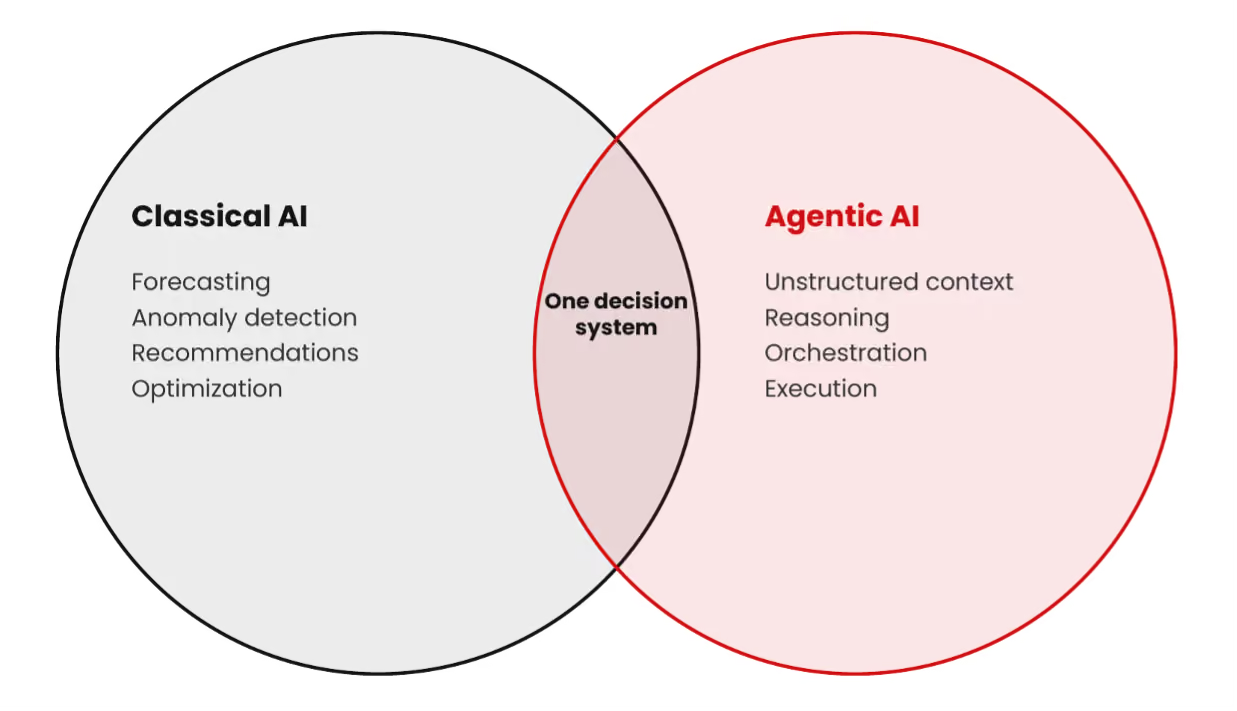
We are building these systems today in wholesale, distribution, import and export and container terminal operations. Vast data volumes, high decision frequency, real money on every decision, and a lot of context that never makes it into a database.
At Faktion we have been building classical forecasting, anomaly-detection and optimisation systems for more than 10 years, while also pushing the frontier the last few years in generative and agentic AI. Agentic AI widens that stack at both ends, context in and execution out; it does not remove the engineering disciplines that make the result reliable.
Predict. Optimise. Reason. Act. Evaluate. Govern.
One decision loop, six roles, each with an owner built for it.
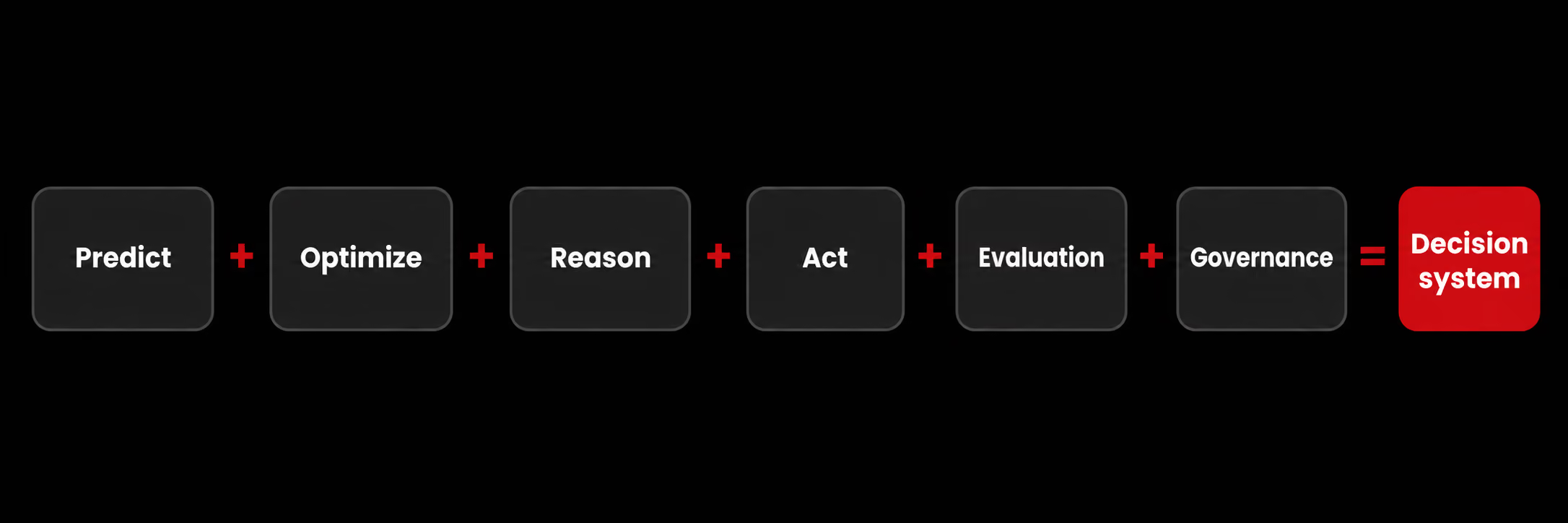
- Predict: demand, sell-through, stock-out risk, customer decline, dwell time, anomalies. Statistical and ML models on calibrated metrics.
- Optimise: the best feasible action within margin, stock, credit, capacity and service constraints. Operations research: solvers, mathematical optimisation, simulation.
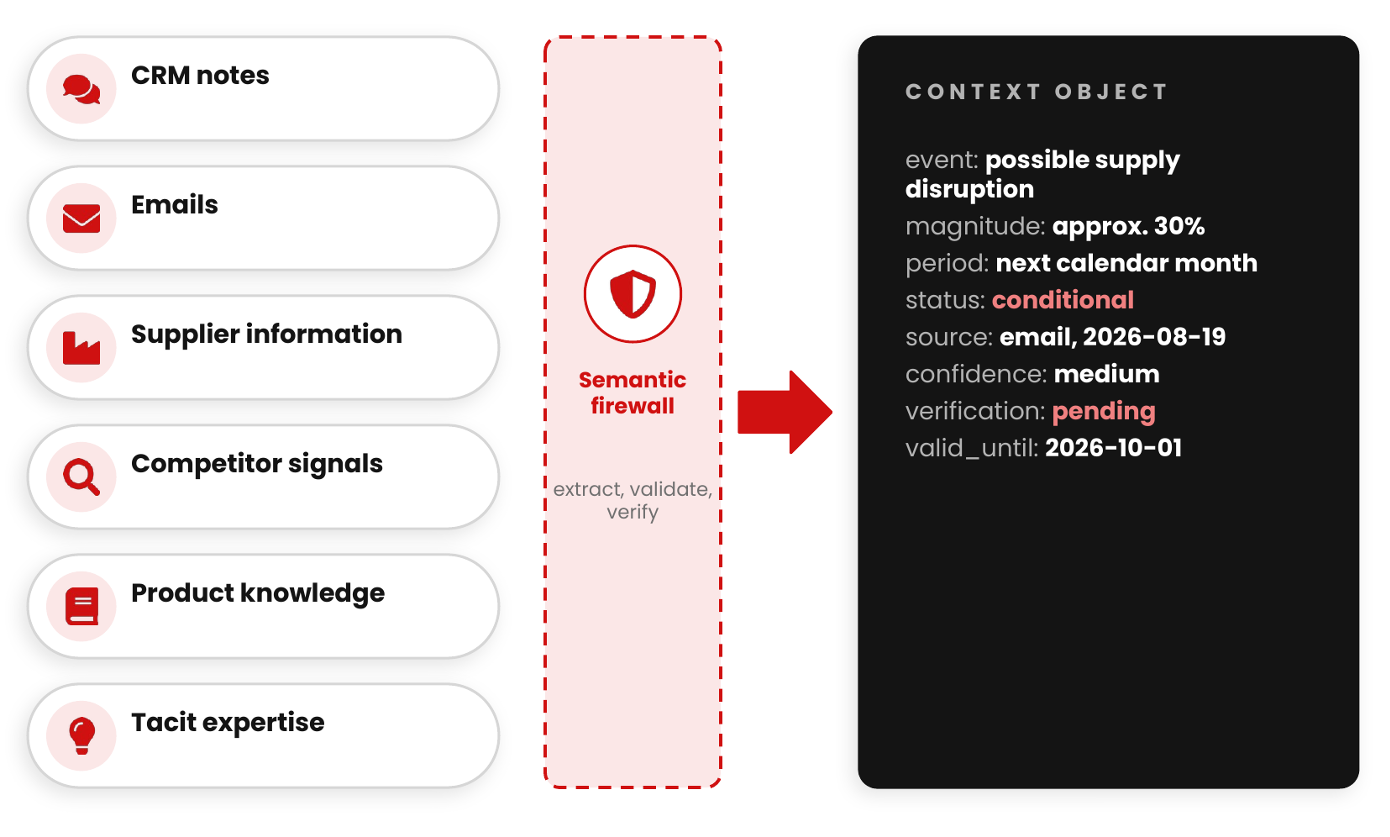
- Reason: CRM notes, emails, supplier messages, product knowledge, tacit expertise. Language models and retrieval, behind a validation boundary.
- Act: a task, an evidence-backed proposal, an approval request or a transaction, via orchestration and APIs.
- Evaluate: domain experts in the loop, LLM-as-judge where useful. Quality gets measured, not assumed.
- Govern: what is allowed to happen at all. Rules, permissions, approvals, audit. All of it outside the language model.
Why forecasting is hard exactly where you decide
A wholesaler carries 15,000 to 30,000 or more SKUs across warehouses, countries and segments. Every extra dimension (warehouse, customer, week) multiplies the number of series to forecast, while each individual series holds fewer data points. Intermittent demand is the norm. A language model does not fix that, and the cost of asking one grows with every series.
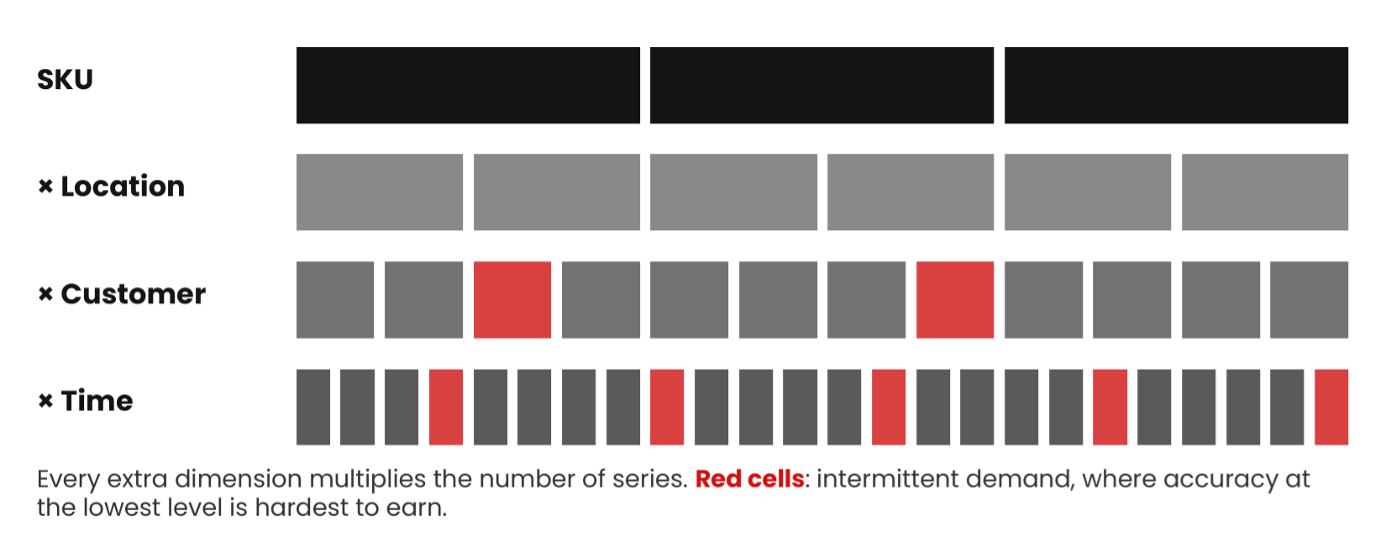
The right question: “at what level is a prediction reliable enough to improve a valuable decision?” Sometimes the answer is probabilistic forecasting, sometimes aggregate and reconcile, sometimes plain anomaly detection. And often the better question is: what is changing right now that requires action?
From data point to governed action
A forecast gives you a data point. Not yet a decision, and certainly not a result.
Filter first, reason second. Deterministic and predictive components screen the full population and shortlist the few hundred cases that matter. Only those get the expensive, non-deterministic reasoning with customer, supplier and market context. That keeps latency, token cost and the error surface under control.
Reasoning can also enter earlier: a supplier email describes a delay, a customer note reveals a project, a terminal message explains an exception. The agent turns that into a possible event. Fitting the schema does not make it true, so it gets validated first.
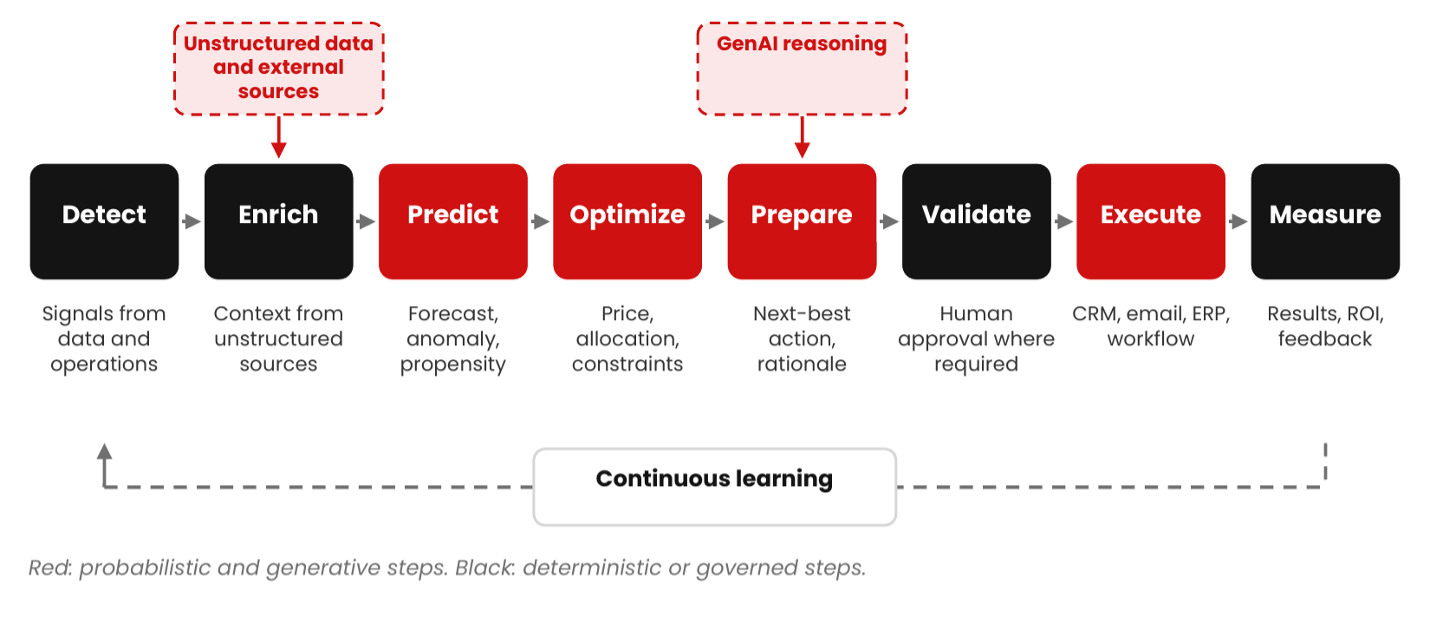
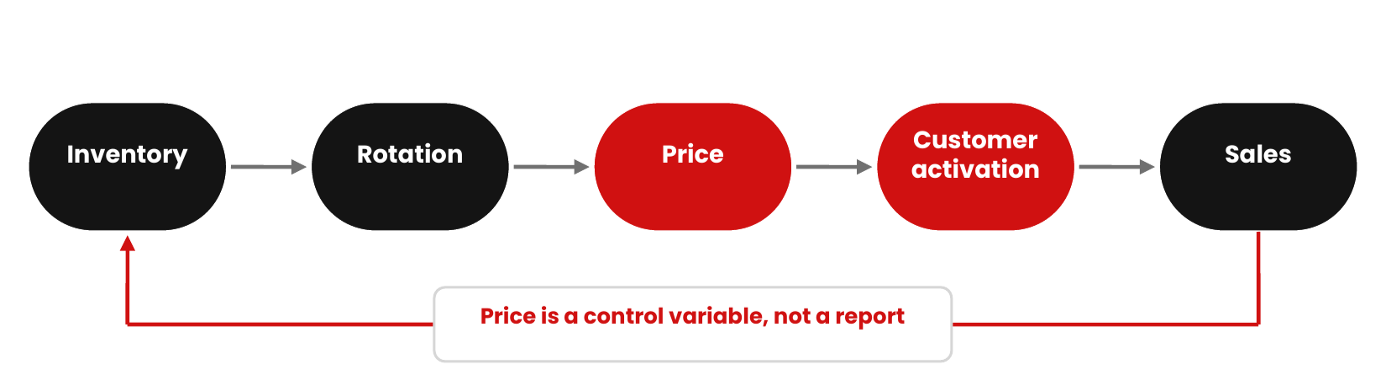
Slow movers, concrete. Prediction flags abnormal rotation and estimates sell-through. The optimiser weighs the alternatives: a price corridor, a transfer, a bundle, selective activation, or no action. The agent finds relevant customers with the evidence attached: why this account, why this product, why now. Rules guard margin floors, credit limits, available stock and seller authority. No price moves without a person approving it.
Fast movers are the mirror image: protect commitments and service levels, hold back discretionary discounts, reallocate stock, buy earlier, warn the account teams. Rotation is the signal; price and customer activation are the actuators.
Bounded intelligence
Let language models deal with ambiguous input. Use deterministic systems for authority.
Every extracted fact passes a semantic firewall before it touches an optimiser or a transaction: value and unit, exact source and timestamp, status, confidence, verification, expiry. Product codes resolve against the master data. Units are never implicit. Conditional stays conditional. And the system is allowed to say "unknown", that is safer than a persuasive answer without evidence.
Autonomy follows risk. Prioritising a list or preparing a draft: automatic. A discount within existing seller authority: seller confirms. A stock transfer: planner approves. Margin-floor exceptions, contract prices, orders and payments: progressively stricter controls, outside the agent. Oversight is designed into each action from the start, not bolted on afterwards as a thumbs-up widget.
Measure the chain, prove the uplift
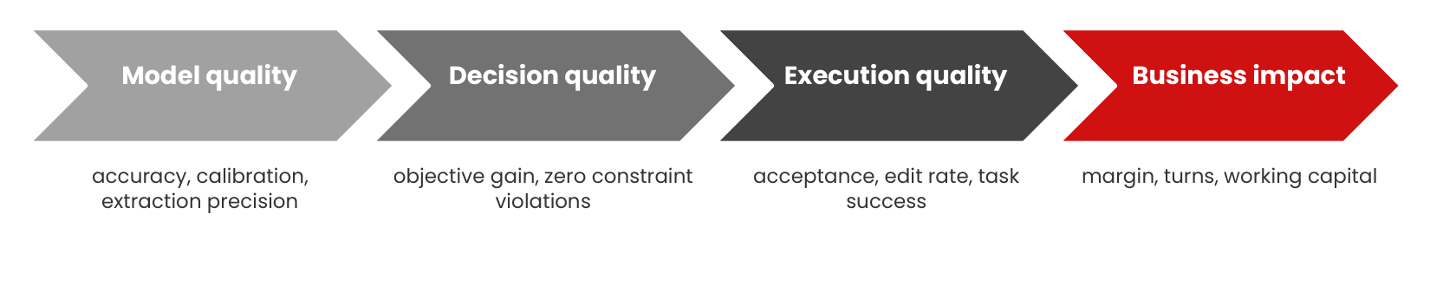
Four KPI layers: model quality, decision quality, execution quality and business impact. Every layer can look great while the next one fails, so we observe the chain end to end.
And prove incrementality before scaling: treated cases against an eligible untreated control group, with labelled ground truth. "Ten thousand recommendations generated" is activity, not ROI.
What it takes
The hardest problems sit at the interfaces: master data, the exceptions sales negotiated, ERP permissions that are wider than the task needs, and adoption by the planner on a Monday morning. That is integration engineering across data, prediction, calculation, agentic reasoning, security and software. The 10+ years of classic AI delivery is what makes the judgement calls possible: which parts stay fixed rules, where a model earns its place, and how much autonomy the business can safely absorb.
Where do your decisions get stuck today? Bring us the process where forecast, plan and execution stop lining up. We map what the decision system needs and what it takes to run it in production. Let's talk.


.avif)












.avif)