Over the past year, enterprise AI conversations have shifted fast. The spotlight moved from chatbots to agents, from Q&A to automation, from augmentation to end-to-end workflows.
That shift is in the right direction, but many organisations are simply skipping a step that they cannot afford to skip. They attempt to automate complex workflows before stabilising the knowledge those workflows depend on. That is where many enterprise AI initiatives start to break down.
To be clear, not every AI use case inside an organisation requires retrieval. Many valuable applications rely primarily on pre-trained model knowledge, structured inputs, or deterministic tooling. Classification, summarisation, routing, enrichment, and certain forms of automation can work perfectly well without access to proprietary knowledge.
The challenge emerges when organisations move towards agentic, multi-step workflows that must reason across business context, internal rules, historical decisions, and domain-specific constraints. In those scenarios, AI is no longer just generating text. It is participating in decisions. At that point, reliable retrieval becomes essential.
Enterprise AI is only as good as the knowledge it uses. LLMs are brilliant, but they do not know your business. They are unaware of your HR policies, contract templates, product constraints, pricing rules, or regulatory exceptions. Without a structured way to access internal knowledge and ground their actions in that knowledge, AI systems' output becomes inconsistent, hard to trust, impossible to govern and fragile at scale.
This is not a tooling problem, it is a foundation problem. RAG is often described as “a chatbot that talks to documents”. That framing significantly undersells its role.
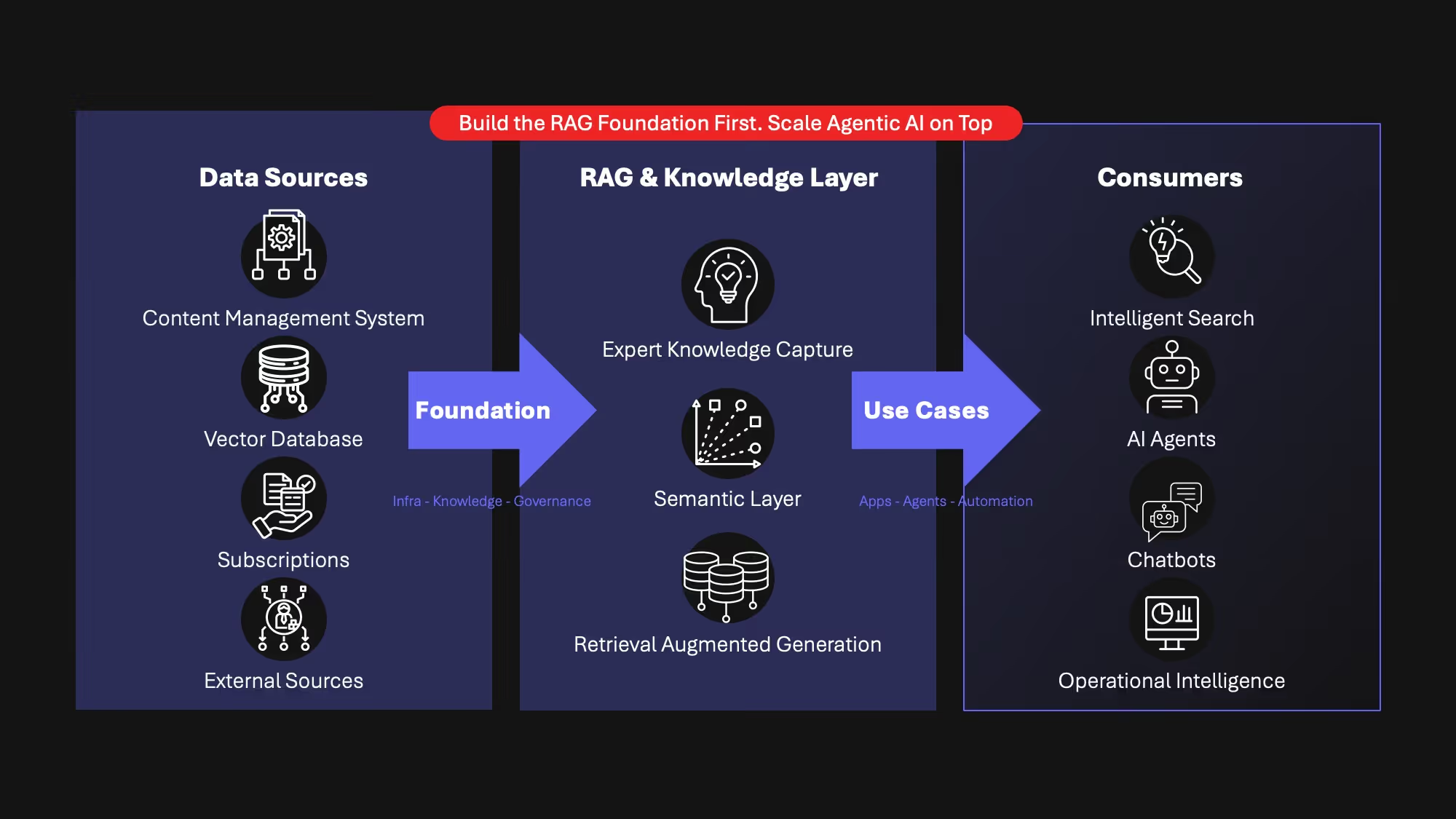
In practice, RAG is a knowledge infrastructure layer that enables three critical capabilities:
- Grounded reasoning
Every answer can be traced back to approved sources. - Governance by design
Permissions, versioning, audit trails, and ownership live in the knowledge layer. - Reusability across use cases
The same foundation supports HR, Legal, Support, Sales, and Operations.
It is also worth recognising that finding and interpreting information is work in its own right. Interpreting a sixty-page policy is a workflow. Synthesising risk from multiple sources is a workflow. RAG already delivers value by supporting these activities, even before a single task is automated.
This post explains why enterprise AI initiatives fail when this foundation is missing, what a RAG-first approach actually enables, and how it allows organisations to scale agentic workflows responsibly on top.
Why Enterprise AI Breaks Without a RAG-First Foundation?
Before you automate workflows, delegate tasks, or deploy agents at scale, you need a solid answer to one question: what knowledge is AI allowed to use, and why should anyone trust it?
This is where a RAG-first foundation becomes non-negotiable:
- Enterprise AI is only as good as the knowledge it uses
Generic models do not know your policies, contracts, internal rules, or historical decisions. RAG makes internal knowledge accessible to AI in a controlled and contextual way. It is the difference between sounding smart and being correct in your organisation. - Hallucinations kill trust and adoption
RAG grounds every answer in approved, traceable sources. Users can see where information comes from, verify it, and build confidence over time. That traceability is what makes AI usable beyond demos. - Governance is non-negotiable
A RAG-first approach embeds governance into retrieval by design. Who can access what, which version is authoritative, and how decisions are audited becomes part of the system, not an operational workaround. - One platform, many use cases
A RAG-first platform allows organisations to build once and reuse everywhere. Different domains plug into the same foundation, each with their own knowledge scope, permissions, and evaluation criteria. This is how AI stops being a collection of pilots and becomes an organisational capability. - Faster ROI, lower risk than fine-tuning
RAG delivers impact by improving retrieval, not retraining intelligence. Update content once and every answer improves instantly. No retraining cycles. No model drift management. No brittle custom models.
From RAG to agentic workflows, the right way
The mistake many organisations make is treating RAG and agents as two competing ideas.
They are not. The real shift is from tools to foundations, and then from foundations to agentic workflows.
Most organisations still take a tool-centric approach:
- Add a chatbot on top of existing processes
- Automate individual questions instead of outcomes
- Shift work around rather than reduce it
- Measure success by usage metrics instead of business impact
This approach looks fast, but it does not compound. Every new use case becomes another custom build, another exception, another fragile system to maintain.
The alternative is a RAG-Foundation first approach:
- Build a production-grade RAG foundation first
- Centralise ingestion, indexing, metadata, and governance once
- Deploy baseline use cases in the tools employees already use
- Collect real usage, feedback, and evaluation signals
- Expand into task-oriented agents where delegation actually makes sense
This is not slower; it is how you avoid rebuilding your AI stack for every new idea.
RAG, in this model, plays a dual role:
- On its own, it delivers immediate value by improving access to knowledge and decision quality.
- As a foundation, it becomes the trusted knowledge backbone that agentic workflows depend on.
In HR, this often starts with reliable policy answers. From there, it evolves into intake agents, case history checks, policy validation, and answer drafting, all grounded in the same knowledge layer.
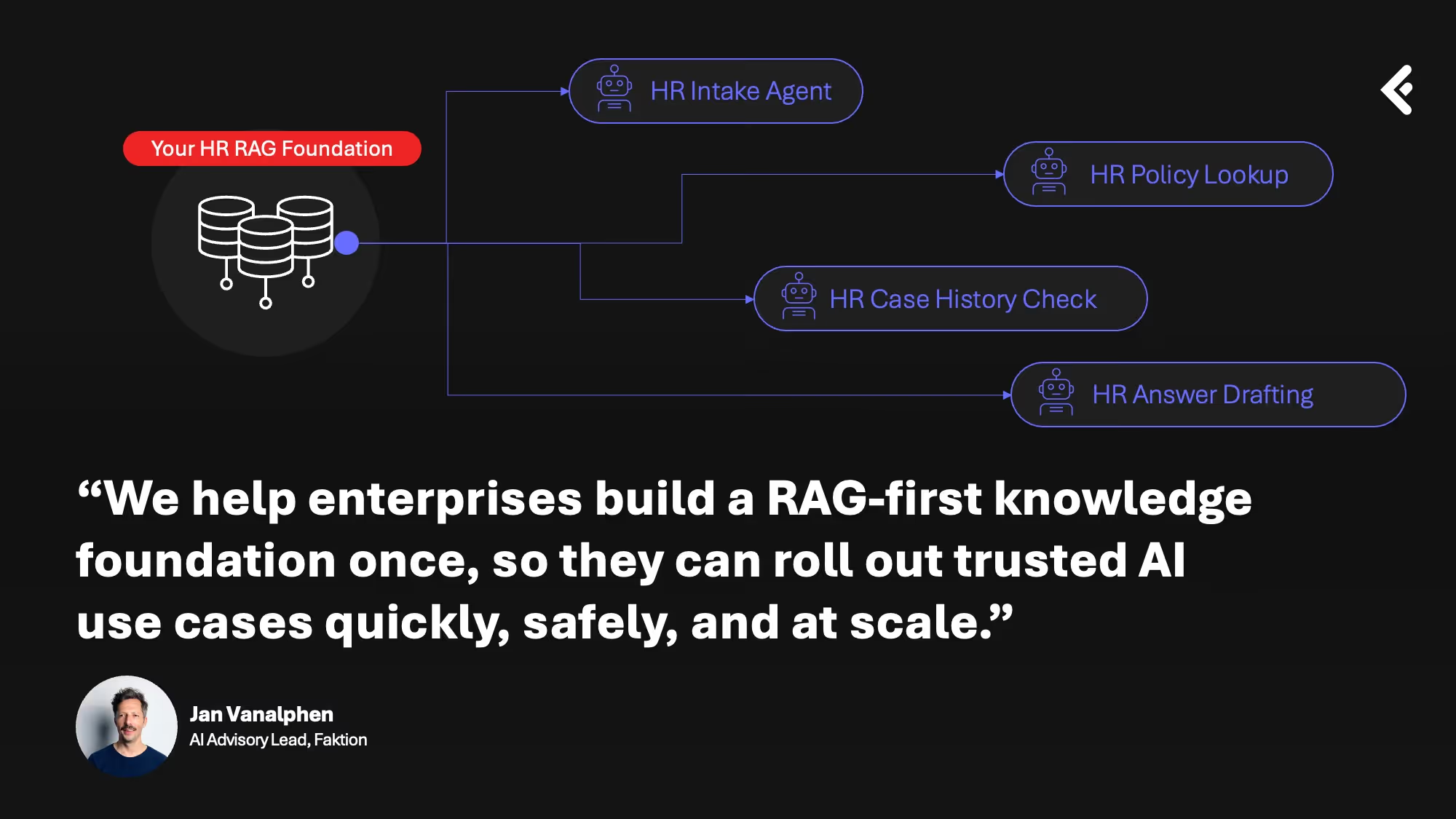
In Sales or Marketing, the same foundation enables lead research, proposal retrieval, positioning alignment, and outreach preparation.
Different workflows, same backbone.
A more honest mental model
RAG will never be perfect; neither are humans, and neither is SharePoint.
Perfection is the wrong benchmark; trust, traceability, and continuous improvement are the right ones.
A well-designed RAG foundation does three things that matter in practice:
- It delivers immediate value by reducing the time spent searching and interpreting information
- It exposes data gaps early instead of hiding them behind confident answers
- It creates evidence to decide which workflows are safe and valuable to automate next
This is what moves enterprise AI out of pilots and into real adoption, not better prompts. Not bigger models. Better foundations.
Closing thoughts
The discussion is often framed as a choice between RAG and agents. That framing is misleading. The real question is:
Do you trust your knowledge enough to let AI act on it?
Most enterprises rely on knowledge that is fragmented, outdated, and inconsistently governed. Humans compensate for this through judgement and informal correction. AI cannot. When autonomy is added on top of unstable knowledge, uncertainty does not disappear, it scales.
A RAG-first foundation does not promise perfection. It creates trust. It makes knowledge traceable, exposes gaps early, and provides evidence about where AI can safely assist and where it cannot. Over time, that foundation earns the right to delegate more work to agents.
Seen this way, RAG is not a detour on the road to automation. It is the path that makes agentic workflows defensible, scalable, and worth deploying in the first place.


%20(1).avif)
.avif)

.avif)