In the previous article, we argued that most enterprise AI initiatives fail not because of model quality, but because they skip the knowledge layer. A RAG-first foundation is what makes AI trustworthy, governable, and scalable in real organisational settings.
This follow-up article focuses on the practical side. It explains the reference architecture behind a production-grade knowledge assistant and outlines a phased approach to evolving that foundation into agent-powered workflows without repeatedly rebuilding the underlying system.
The goal is not speed to demo, but durability in production.
Reference architecture: how a trusted knowledge assistant operates
At the core of the architecture is a simple but strict principle: reasoning and retrieval must precede generation. Enterprise AI systems should never start by producing answers. They should first understand what is being asked, determine which knowledge is relevant, and validate that the retrieved information is sufficient before responding.
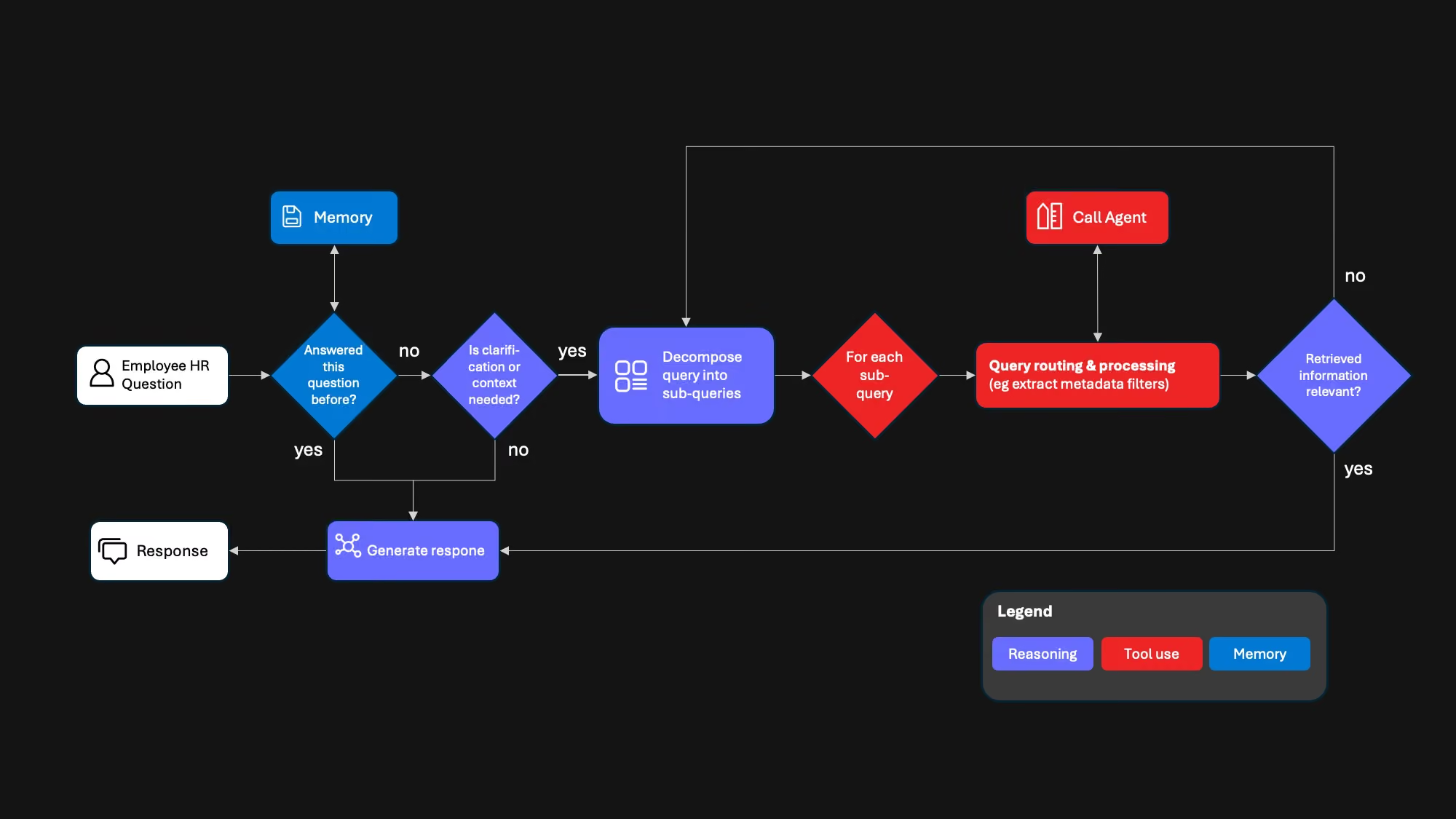
A request typically enters the system as an employee question. The first step is to check whether a similar question has already been answered and validated. When this is the case, the system can reuse a known, trusted response, which improves consistency and reduces unnecessary processing.
If the question is new or ambiguous, the system assesses whether additional clarification is required. Rather than guessing, it asks follow-up questions when context is missing. This behaviour alone significantly improves reliability in knowledge-heavy domains such as HR or Legal.
Once sufficient context is available, the system decomposes the question into smaller, more precise sub-queries. Most enterprise questions span multiple documents, policies, or historical decisions. Decomposition ensures that retrieval remains targeted and controllable rather than broad and brittle.
Each sub-query is then routed through a governed retrieval layer. Metadata filters, permissions, versioning rules, and source prioritisation are applied to ensure that only approved and relevant knowledge is accessed. Where necessary, specialised tools or task-specific agents are invoked, such as policy lookups or case history checks.
Before a response is generated, the retrieved information is evaluated for relevance and coverage. If confidence thresholds are not met, the system can refine the query, escalate the case, or route it to human review. Only when sufficient, trustworthy context is available does the system generate a response. Validated outputs can be stored as memory, allowing future queries to be resolved more efficiently and consistently.
This architecture is not optimised for cleverness. It is optimised for control, traceability, and long-term trust.
A phased approach to implementation
Translating this architecture into practice requires a staged approach. The objective is to build confidence and reuse incrementally, rather than committing to full automation upfront.
Phase 0: Discovery and knowledge alignment
The starting point is not technology, but knowledge. Organisations need a clear understanding of the quality, coverage, and ownership of their existing information. This includes identifying gaps, inconsistencies, outdated content, and risk areas.
At this stage, scope boundaries and success criteria are defined, and initial use cases are prioritised based on real employee questions rather than hypothetical scenarios. This alignment phase prevents AI from being positioned as a solution to problems that are fundamentally organisational.
Phase 1: Infrastructure setup
With a clear scope in place, the next step is to establish a secure, production-ready environment. This includes deploying the necessary infrastructure, configuring core RAG components, and setting up governance, security, and observability.
The emphasis here is on reusability. The environment should be designed to support future use cases without requiring structural changes.
Phase 2: Knowledge foundation build
In this phase, knowledge is consolidated into a managed, AI-ready foundation. Documents are ingested into a central knowledge base, metadata and semantic structures are defined, and retrieval strategies are optimised.
Coverage is validated against priority topics to ensure that the system can reliably answer the questions it is expected to handle. At the end of this phase, the organisation already has a functional knowledge assistant that delivers tangible value.
Phase 3: Baseline deployment and evaluation
Rather than building custom user interfaces, a baseline RAG assistant is deployed in existing tools, such as Microsoft Teams. This allows real users to interact with the system in their daily workflows.
Feedback and evaluation signals are captured to understand where the system performs well and where it falls short. These insights are used to improve ingestion, metadata, and retrieval, rather than immediately expanding scope.
Phase 4: Workflow reimagination
Once the knowledge foundation is trusted, workflows can be reconsidered from first principles. Instead of starting from existing tools, organisations analyse employee intent, friction points, and decision moments.
This leads to a task-oriented workflow blueprint that defines which steps can be handled by AI, which require human judgement, and where handoffs should occur. This blueprint becomes the basis for introducing agents responsibly.
Phase 5: Incremental agent deployment
Specialised agents are introduced gradually, each with a clearly defined task and success criteria. Examples include intake agents, policy interpretation agents, or drafting assistants.
Performance is measured in terms of accuracy, task completion, handover quality, and workload reduction. Automation expands only where trust has been earned.
Phase 6: Expansion and reuse
Once validated in one domain, the same foundation can be reused across others. The underlying RAG platform remains stable, while domain knowledge and agents evolve. This is what allows enterprise AI to scale without constant architectural resets.
Closing perspective
Agents are not the starting point of enterprise AI maturity. They are the result of a trusted, governed knowledge foundation.
A RAG-first approach does not slow organisations down. It prevents them from rebuilding the same system repeatedly under different names.
Before investing in agents, the most important question remains a simple one: do you trust your knowledge enough to let AI act on it?
If not, the foundation comes first.

%20(1).jpg)


.jpg)

.jpg)