Spend enough time around people who have become genuinely good with AI tools, and you notice a pattern. They have automated their own admin, sped up their own drafting, and compressed a Friday afternoon’s work into twenty minutes. They are, individually, flying. And yet the organisation around them moves at roughly the speed it did a year ago. The hall is full of remarkable musicians, and not one of them is in tune with the others.
That gap is the whole story. Taking the lead with tools is the easy part, and increasingly, everyone is doing it. Leading AI transformation is a different responsibility: helping the whole organisation move together. It is harder, less celebrated, and the only version that actually changes the numbers. Here is why personal productivity is not transformation, and what the move from one to the other really involves.
Personal Productivity Is Not Transformation
Ask whether AI can make you ten times more productive and the honest answer is often yes. That is precisely what makes it dangerous. A tenfold jump in individual output sounds like a win, but output is not the same as throughput. If you produce ten times faster and everything downstream of you (the review, the approval, the handover, the next desk) still runs at the old speed, you have not removed a bottleneck. You have become one. Drop a 10x individual into a 1x process, a process designed around human limits, and all you get is an accelerated queue: more drafts, more analyses, more output piling up for everyone else to review. The work moves no faster, and burnout is waiting around the corner.
Scale that pattern across a company and you get a two-speed organisation: a small group of AI-fluent people building private islands of automation, and everyone else working precisely as before. That is not the harmless outcome it looks like. It is a trap on three levels. One person’s speed becomes another’s bottleneck. AI does not only accelerate the good work, it also amplifies the bad ways of working you already had. And it breeds a false sense of progress, because optimising your own link quietly distracts everyone from the harder question of how the whole chain should be designed.
So an AI elite is not a transformation. It is a handful of very efficient people waiting on everyone else, while the bottlenecks simply move around. A chain only moves as fast as the links you have not touched.
What AI Actually Does, and Where It Hits a Wall
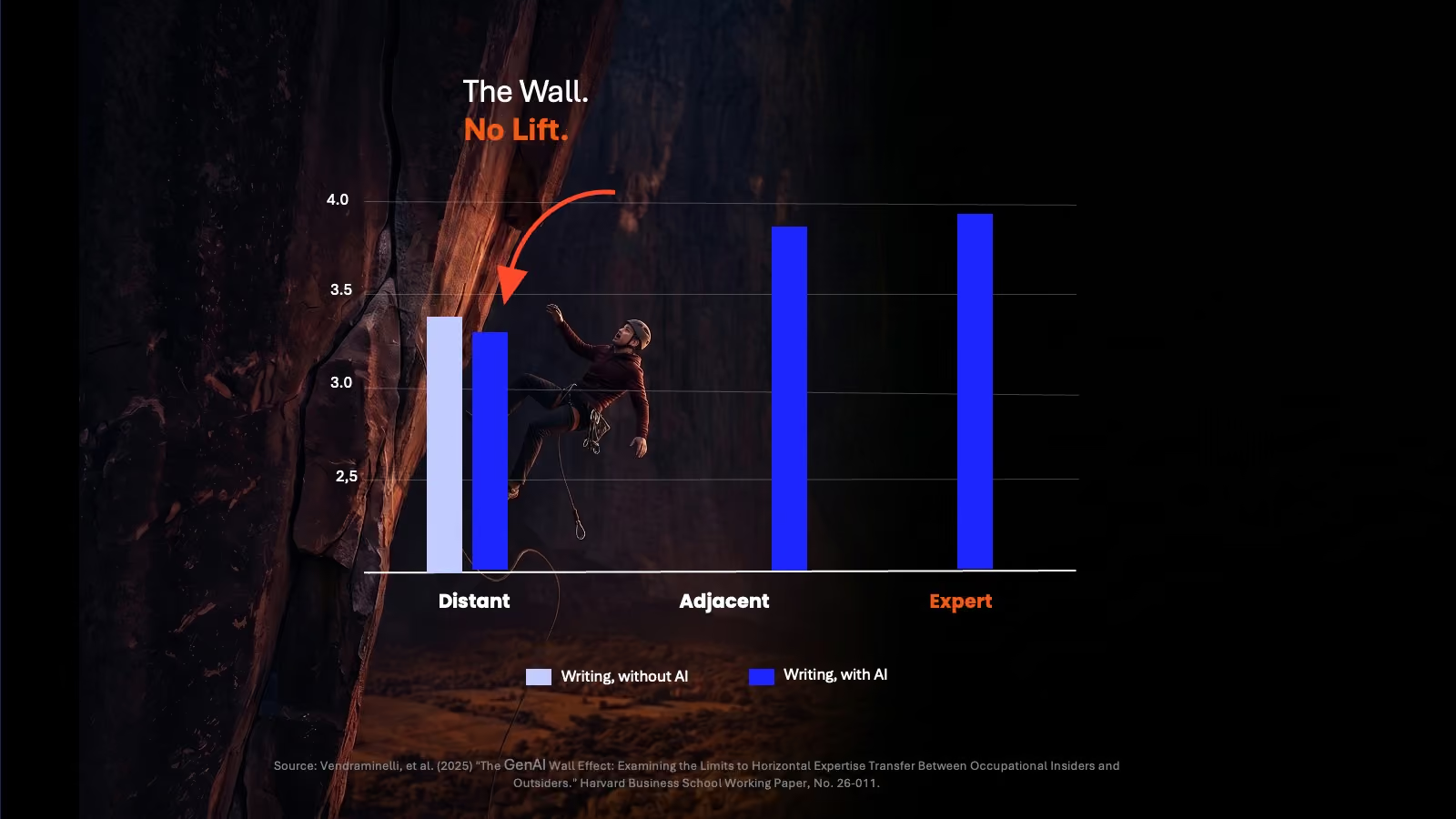
Before redesigning anything, it helps to be precise about what these tools do and do not do. Recent research from Harvard Business School puts numbers on it, as we covered in Who’s already building the organisation around The GenAI Wall?. The wall is the point at which AI stops meaningfully closing the gap between experts and non-experts. Give three groups (specialists, adjacent colleagues, and distant outsiders) the same two tasks and a clear pattern emerges. On the conceptual task, framing the problem and outlining an approach, all three climb almost to expert level. AI is a genuine equaliser. On the execution task, the actual finished work, only the specialists and their adjacent colleagues improve. For the distant outsiders, the gain is roughly zero.

The reason is uncomfortable but simple: you cannot reliably judge work you could not have produced yourself. AI will hand a non-expert a confident, polished answer, and a non-expert has no way to tell whether it is right. So the practical lesson is not that AI is overhyped. It is that the wall is a map. It shows you where AI substitutes for expertise and where it only impersonates it, and that distinction is the foundation everything else is built on.
Diversify the Work, Then Allocate It
The wall is low for some tasks and high for others. It is low wherever work is narrow, structured and easy to check: extraction, classification, routing, fixed-template summaries, ticket triage, invoice tagging. These are tasks where the criteria can be written down and the output verified against the source. It is high wherever work is open-ended, subjective, context-heavy or high-stakes: strategy, legal reasoning, executive communication, risk interpretation, the judgement calls where a convincing answer can still be the wrong one.
Once you can see that split, the leadership question stops being “who is good with AI” and becomes “how do we allocate the work”. The pattern is consistent. Distant outsiders need narrow tasks, guardrails, verification and learning loops. Adjacent colleagues can produce quickly, and cross-functionally, once the context and criteria are clear. Experts own the criteria, the judgement, the quality bar and the exceptions.
It also helps to drop the fantasy of the single perfect output. Almost no business runs, let alone grows, on one flawless article produced at human speed. What moves a company forward is leverage: far higher volume at almost-perfect quality. Pointed at the right tasks, AI can deliver something like five times the volume at roughly ninety percent of expert quality, and ninety percent at five times the volume is far easier for an expert to lift to excellent than a blank page ever was. That is exactly the leverage you want, provided you have decided in advance which tasks those are.
Don’t Automate. Re-imagine.
Here is where most AI efforts stall: they bolt a tool onto yesterday’s process and call it transformation. That is glorified automation, and it mostly buys you a slightly faster version of a process you probably should not be running anymore. Real transformation asks a harder question. If AI had existed from day one, would you have designed the work this way at all? Most of the time, the honest answer is no.
Every process you run today was built around three human limits: limited capacity (only so many people), limited visibility (you learned things late), and limited speed. Every handoff, every rule, every “we have always done it this way” was a workaround for one of the three. AI quietly removes all three. Capacity becomes effectively unlimited, everything can be read at the door and at once, and speed stops being the constraint. So the uncomfortable question is this: if the limits you designed around are gone, why is your process still shaped around them?
Stop Optimising the Link. Redesign the Chain.
This is why you cannot simply sprinkle AI on top of what you already have. The work is not a stack of separate tasks, it is a chain: people, systems, documents, decisions, all linked. You can polish any single link until it shines like gold, and the chain will still snap at its weakest weld. Making yourself 10x faster does not fix the chain. It just makes one link gleam.
Complex processes hide this in plain sight. An insurance claim is one sentence from the outside (submit a claim, get paid) and a thousand branching channels from the inside: the case arrives by email, broker or form; documents and photos and policies pile in; data is missing, so the file waits; liability is unclear, public road or private property; injuries need empathy and evidence; exceptions escalate to a human. Processes look simple from the outside and look like rivers once you are in the water. You cannot redesign what you do not first understand, especially where it stalls and why.
There are three levels at which you can act. At the task level you ask how to do this faster, and the answer is usually a tool. At the workflow level you ask how these tasks hand over without friction, and agentic systems can connect them and take actions between them. At the process level you ask how the work should be designed now that AI exists, and that is transformation. Most companies are stuck, brilliantly, at level one. If you keep one sentence from all of this, keep this one: AI transformation starts the moment you stop optimising the link and start redesigning the chain.
Move People Up the Value Chain
This is the part that decides whether transformation is something done to people or with them. The honest first reaction in the room is always the same question: does this mean fewer people? Redesigning the chain should move people out of the work that never really needed a human: the rubber-stamp reviews, the manual rework and waiting, the email glue between desks, the endless checking, copying and routing. The glue stops being people forwarding messages to each other and becomes the system itself. And it should move them into the work only a human can hold: defining the criteria and guardrails, validating the exceptions, making the judgement calls, coaching and improving the system.
The phrase worth keeping is human up, not human out. This is not losing your job to a machine. It is losing the part of the job that was only ever human by necessity, not by design, the work that drained you, in exchange for more of the work that is actually worth a human. The goal is not to remove people from the value chain but to shift them up it, into accountability, control and judgement, precisely the territory the wall says machines cannot reach. The people whose routine tasks disappear are not displaced. They are promoted into the work that was always the point.
Pick Up the Baton
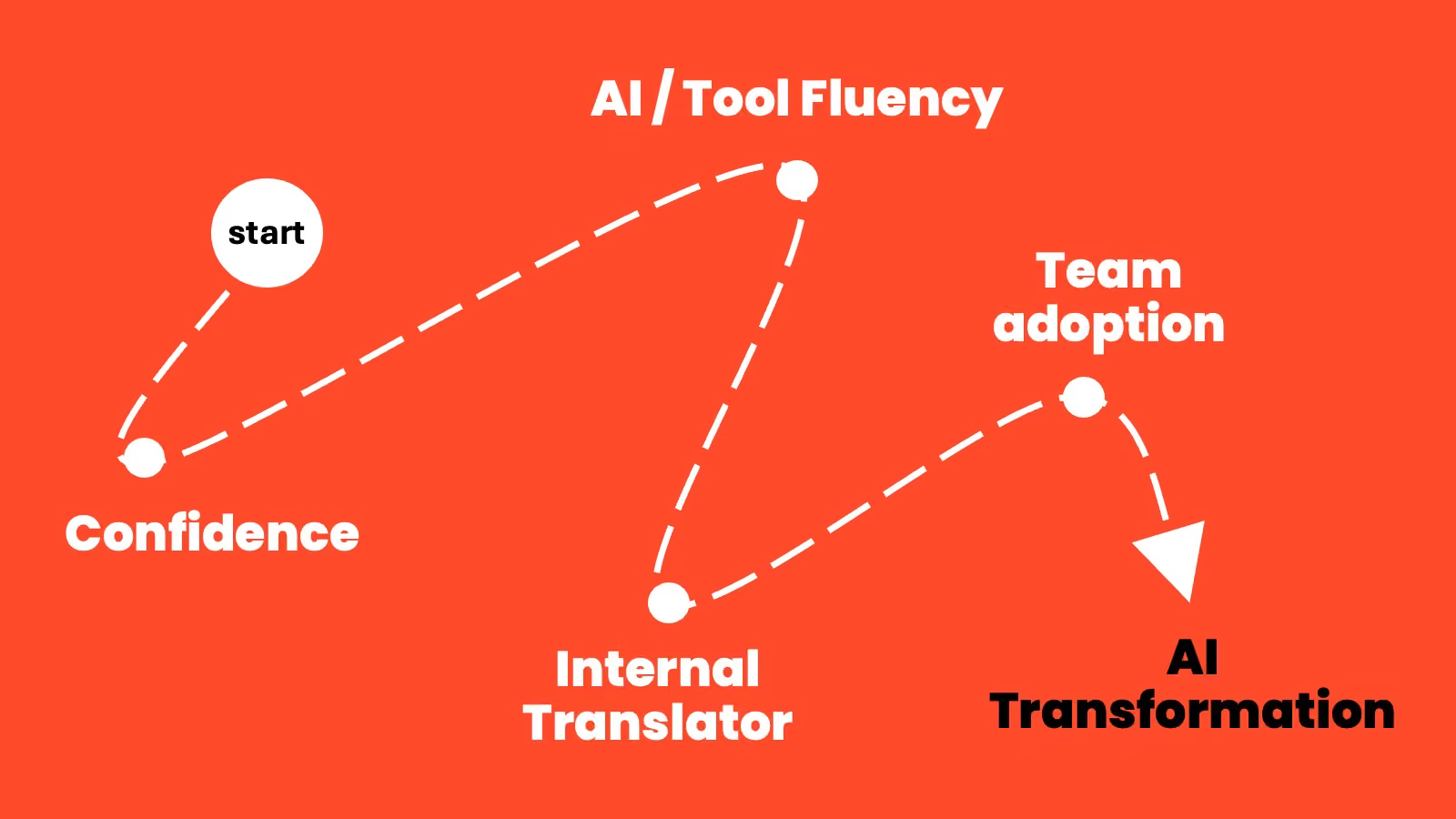
None of this requires a grand programme to begin. The full sequence is simple enough to name: spot the bottlenecks, prioritise the high-impact ones, translate the change into daily work, redesign the process rather than the task, and share the practice so it stops being one person’s private advantage. Five steps is a lot when you are busy, so forget four of them. Here is the only move that matters this week: name one place in your team where work sits in a queue, waiting on a single person. That queue is your bottleneck, the spot where the river backs up. You do not have to fix it yet. Go and look at it. That is the whole first step.
Do that across enough processes and you stop having a faster team and start having a faster organisation, an operating system that out-thinks and outruns competitors who are still automating their broken processes one task at a time. So for anyone who has already taken the lead with tools, the responsibility now is to go one step further. Do not play louder. Your organisation does not need another brilliant soloist; it needs someone willing to put the instrument down and pick up the baton. At Faktion, that is the work we do every day: turning AI from personal productivity into redesigned processes, and from islands of automation into systems that move as one. If that is the conversation you want to have, let’s talk.

%20(1).jpg)


.jpg)

.jpg)