Artificial intelligence is succeeding spectacularly in the hands of individuals, and struggling inside companies. Millions of people are already automating parts of their work with AI, while enterprises wrestle with pilots, governance, and stalled initiatives. The missing link may not be better models, but a better unit of progress: small, reusable AI workflows called skills.

For decades, artificial intelligence followed a predictable path into society.
It started in research labs, moved into industry, became reliable and invisible infrastructure, and only years later appeared in consumer products. By the time most people realized they were using AI, it was already mature.
Think about the pattern. When Spotify launched Discover Weekly, recommendation systems had already been battle-tested in Amazon and online advertising. When Siri arrived, speech recognition had spent decades in call centers, hospitals and defense systems. When Google Translate became mainstream, machine translation had already been industrialized by governments and global enterprises.
Consumers never met AI in its infancy. They met it once it had become boring. Invisible. Trusted.
That was the pattern. Until 2022.
ChatGPT was not the first chatbot, nor the first large language model. What made it historically unusual was timing: a frontier AI system was placed directly into the hands of hundreds of millions of people before it was fully industrialized. For the first time, the public did not meet AI as infrastructure. We met AI as a raw capability.
We began using a technology while researchers were still figuring it out, while companies were still discovering what it was good for, and while society was still deciding how to feel about it.
The order flipped.
Instead of research → industry → consumers, we now have research → consumers → industry scrambling to catch up.
That reversal explains much of the hype, fear and confusion around AI today. Humanity is learning how to use a general-purpose technology in real time. If we want to understand where AI goes next, we shouldn’t start in research labs. We should start with the people experimenting with it every day.
LLM chatbots are arguably the fastest-growing consumer product category in history. Roughly one in seven humans has used one. That level of adoption does not happen because of hype alone; it happens when a technology becomes broadly useful.
People use AI to write, learn, plan, code, research, translate, brainstorm and solve problems. We are watching the largest usability study in the history of technology, happening in public, in real time.
And then we hit a striking contrast. While consumers sprinted ahead, companies slowed down. The exact numbers are debated, but the reality is not: organizations find it remarkably difficult to turn AI experiments into economic value at scale. On one side, hundreds of millions of people use AI every week. On the other, many organizations struggle to get even a single initiative across the finish line.
So we have a paradox: AI is wildly successful in the hands of individuals and surprisingly difficult inside organizations.
The problem isn’t that AI doesn’t work. It’s that companies lack a mechanism to convert individual experimentation into organizational capability.
The enterprise paradox
Most companies start with the obvious idea: connect AI to corporate data.
This leads to chatbots that talk to documents, assistants that search knowledge bases, and tools that answer internal questions. These are useful. But in the grand scheme of knowledge work, they are small.
Knowledge work is messy, creative and unstructured. It is not just about retrieving information. And so organizations end up applying a transformational technology to incremental use cases and struggle to generate real return on investment.
The gap between how individuals use AI and how organizations deploy it is where the real story begins.
Skills: the emerging unit of progres
So if individuals are ahead of companies, what are they discovering? One emerging pattern is the rise of skills as a reusable component for automating real workflows. The idea gained visibility through tools like Claude, but it’s quickly spreading across the ecosystem, appearing in platforms such as Manus and in emerging marketplaces where people share and reuse automation. Sites like OpenClaw’s Clawhub already host thousands of community-tested skills, hinting at an early open ecosystem of reusable AI workflows.
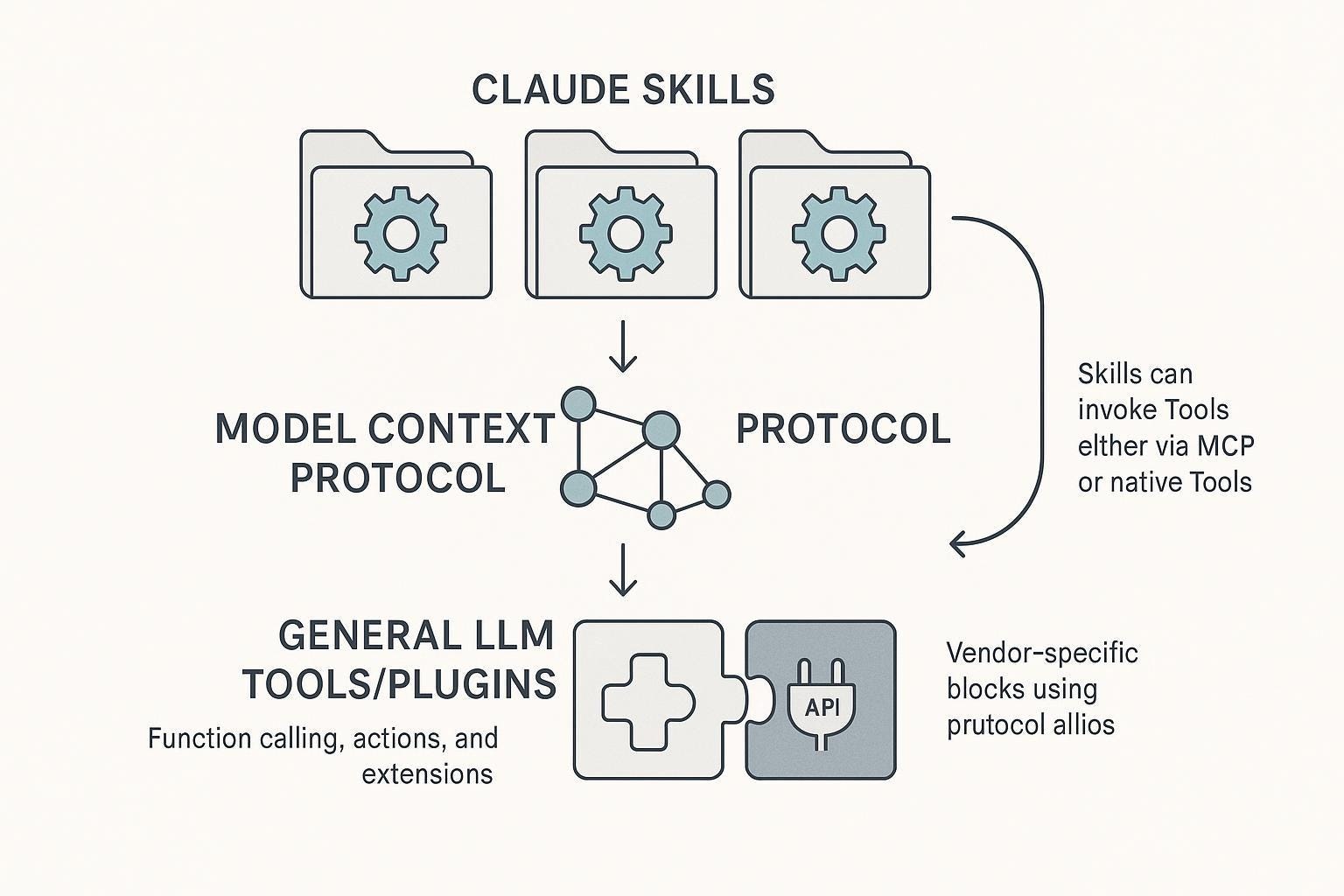
Technically, a skill is a packaging layer around an AI workflow. A skill bundles instructions, domain knowledge, scripts, and access to tools into a reusable module that a language model can invoke when needed. Under the hood, the model uses tool-calling to interact with APIs, software and data sources through a standard interface often called the Model Context Protocol. This allows a skill to search email, read documents, call external services or trigger actions while keeping permissions and guardrails in place. In other words, skills turn a general-purpose AI into a system that can reliably perform a specific job.
Once this becomes possible, a new pattern appears.
An inbox cleaner that scans newsletters and prepares bulk unsubscribe actions every morning. A research assistant that monitors news overnight and delivers a daily briefing. A workflow that turns Slack discussions into ready-to-publish LinkedIn posts. A meeting follow-up agent that turns call transcripts into summaries, tasks and emails.
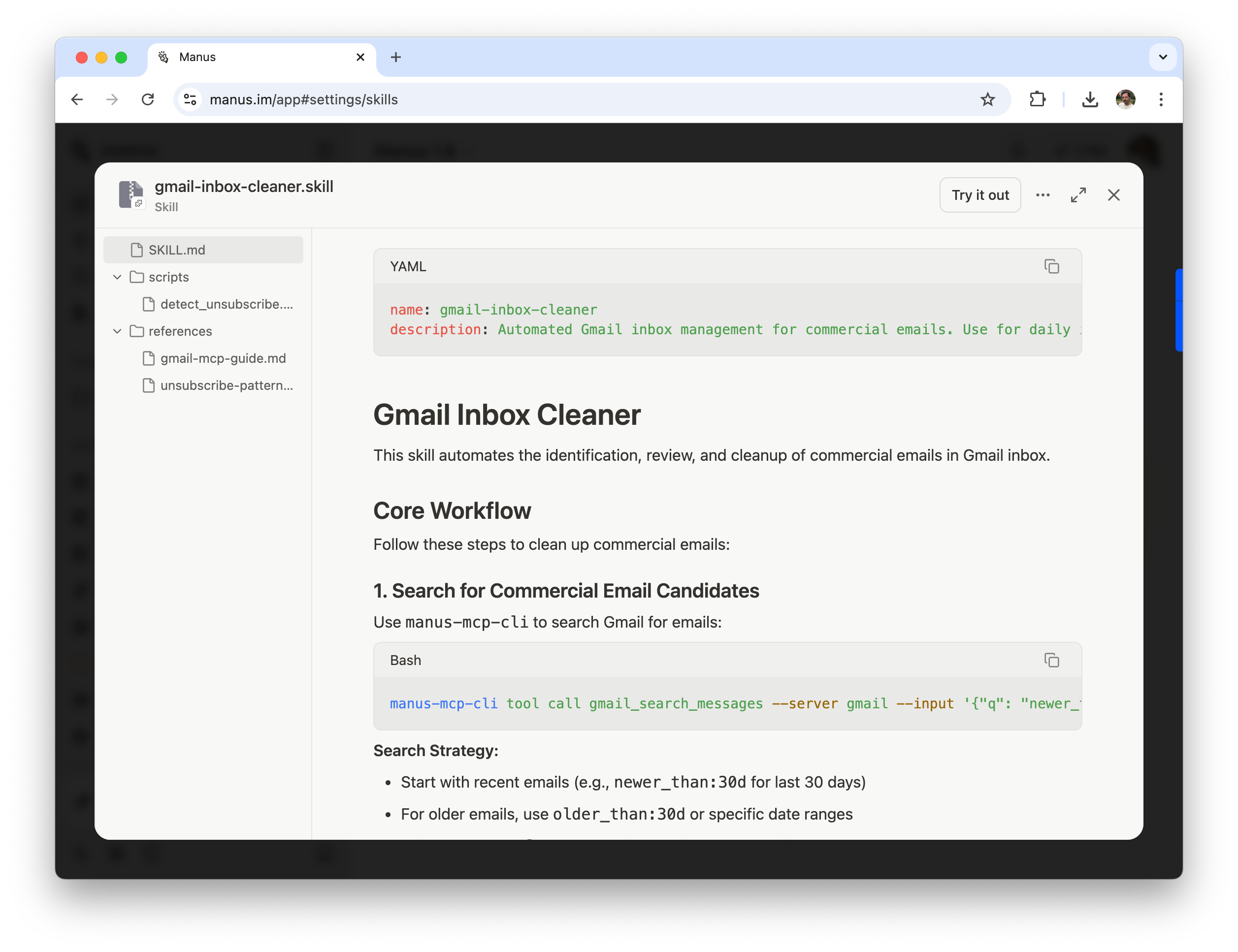
Individually, these automations look small. But their pattern matters. They capture real knowledge work in a reusable form, and they reveal where AI creates real value — not in answering one-directional questions through a chatbot interface, but in doing work. Not in isolated tasks, but in end-to-end workflows. AI produces meaningful return when workflows disappear.
Who's best placed to build
Crucially, creating these workflows no longer requires deep technical expertise. In practice, building a skill often looks like meta-prompting: you describe the workflow in natural language, refine it through a back-and-forth with the system, and the platform generates the underlying scripts, structure and tool integrations for you. Instead of writing code, users describe what the workflow should do, and the system turns those instructions into a reusable automation.
This changes who can participate in automation. Expert workers are suddenly in the driver’s seat — able not only to design their workflows, but to test them, refine them, and use them in their daily work.
And the people best positioned to discover which workflows should disappear are not consultants or steering committees. They are the people doing the work.
When an expert automates their own workflow, discovery, design and validation collapse into a single loop. The use case is real, the design is practical, the validation is immediate, and the ROI is obvious.
This creates a new scaling path for enterprise AI.
A new scaling path for enterprise AI
Individuals build skills to automate their own work.
Teams share and reuse the most useful ones.
Organizations standardize and govern them.
Engineers harden the most valuable skills into enterprise-grade systems.
What begins as personal productivity becomes organizational capability.
Instead of betting on a handful of large AI initiatives, companies can grow hundreds of small, proven automations grounded in real work and validated by real users. Over time, this becomes a library of reusable workflows — an internal automation layer built from the bottom up.
The next wave of enterprise AI will not be defined by bigger models. It will be defined by more workflows disappearing. Skills offer the missing link, a practical blueprint for the kind of enterprise automation industries have been chasing for years.
The real question is whether individual workers will be given the time, space and trust to show the C-suite how it’s actually done.

%20(1).avif)


.avif)
.avif)