A team builds a proof of concept. The demo is impressive. Stakeholders nod. Budget gets approved. And then, somewhere between the boardroom and the production environment, the project quietly dies. Not with a dramatic failure. Just a slow fade into irrelevance.
S&P Global Market Intelligence reports that the share of companies abandoning the majority of their AI initiatives before production rose from 17% to 42% year over year. On average, organisations scrap 46% of AI projects between proof of concept and broad adoption. And McKinsey's 2025 survey found that only 39% of respondents attribute any level of EBIT impact to AI at all. Most of those say less than 5%.
After nearly a decade and 750+ AI projects across industries, from manufacturing companies optimising production processes to financial services firms automating decision making to public sector organisations streamlining service delivery, we have identified five truths that determine whether enterprise AI makes it to production. Or stays trapped in the prototype phase.
These are not abstract principles. They are hard-earned lessons from watching AI projects succeed and fail in equal measure.
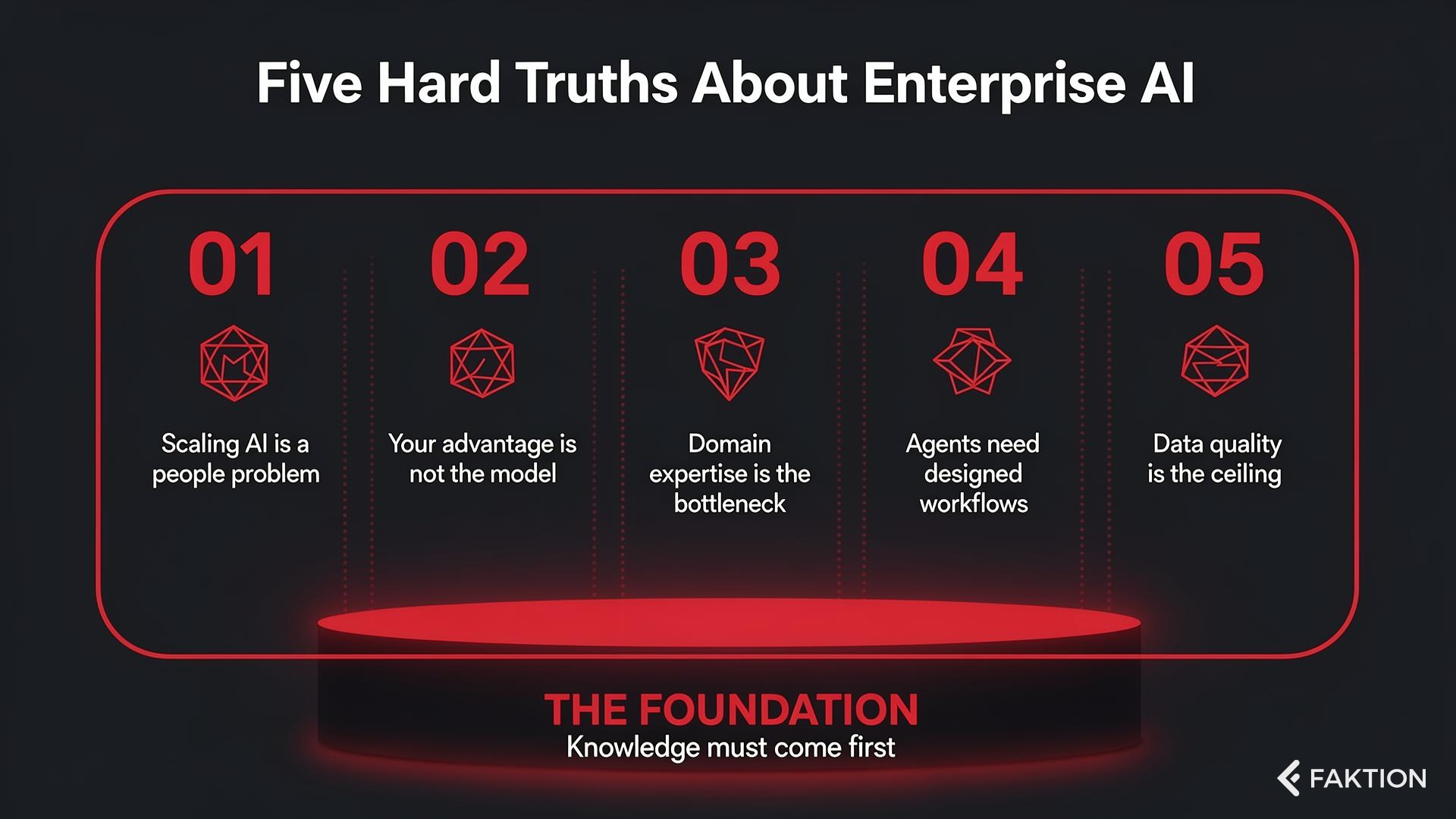
Truth 1: Scaling AI is a people problem, not a model problem
The first thing most organisations get wrong is assuming that scaling GenAI is a technical challenge. It is not. It is a knowledge gap between two groups of people who need each other but rarely speak the same language.
AI engineers excel at building powerful AI models. But they often lack the detailed domain knowledge to make those ai models useful in practice.
On the other hand, domain experts in fields like healthcare, manufacturing, or supply chain management have deep operational insight. But they typically lack the AI tools to influence AI systems directly. This gap is the main reason generative AI initiatives get stuck in prototyping.
Close the gap, and the AI reaches production
At Faktion, we close this gap through product thinking. We build interfaces that put AI in the hands of business users and domain experts. Monitoring dashboards, validation workflows, and no-code builders that let the people closest to business operations shape how AI behaves.
We did this at Ferranti, where our multi-agent knowledge platform put complex technical documentation at the fingertips of consultants who previously spent hours searching. And at Probis, where we built an end-to-end AI-powered recruitment portal that automated document pre-screening and competence-based interview analysis for Belgian municipalities. In both cases, the AI reached production because the humans who depend on it could monitor, manage, and trust it.
Truth 2: Your competitive advantage is not the model
Every organisation has access to the same large language models. The same APIs. The same machine learning algorithms. When the underlying AI technology is identical, it cannot be your differentiator.
Your AI competitive advantage comes from what sits beneath the model: your data, your processes, and your engineering discipline. Proprietary data gives you an edge competitors cannot replicate. Well-defined processes determine whether AI solutions automate real work or just shift it around. And robust software engineering is what turns experiments into production-ready AI systems that business teams can actually rely on.
This applies whether you are building predictive maintenance systems that analyse sensor data from manufacturing processes, quality control solutions powered by computer vision, or AI agents that optimise supply chain management and resource allocation. The model is table stakes. The system around it is where enterprise AI delivers real value. Or fails to.
Truth 3: Domain expertise is the bottleneck, not AI intelligence
Here is an uncomfortable truth that most AI conversations skip over entirely. The performance ceiling of any AI system is not set by how smart the model is. It is set by how well it understands your domain.
AI domain expertise is what separates AI that sounds right from AI that is right. In every enterprise AI deployment, the real bottleneck is not model capability. It is whether domain experts are embedded in the process from day one. They define what "correct" means. They spot errors that data scientists miss. They calibrate AI outputs against real-world operational standards.
Without this, AI systems produce outputs that are technically impressive but practically useless. Whether the use case involves analysing customer data for better decision making, identifying patterns in production environments, or reducing human error in quality control, the domain expertise is what grounds artificial intelligence in reality.
At Faktion, we embed domain experts alongside AI engineers and UX designers from the very first sprint. That collaboration is non-negotiable.
Truth 4: AI agents only work inside well-designed workflows
The market is racing to deploy enterprise AI agents. Intelligent systems that can reason, use tools, and execute tasks with minimal human intervention. The promise is enormous. But so is the failure rate.
From our experience, the agent is not the unit of value. The workflow is. An AI agent without a well-designed workflow is just a smart tool with nowhere to go. It will amplify broken processes instead of fixing them.
Production-ready agent workflows need five structural properties: they must be composable, context-aware, guardrail-driven, observable, and mapped to real business logic. Without these, agents deployed across business operations create chaos instead of operational efficiency.
Cleanlab's 2025 research confirms this: 62% of production teams plan to improve observability as their most urgent investment, and teams increasingly recognise that visibility, real time feedback, and control mechanisms are central to scaling AI agents safely.
At GIS International, we built DIANA, an AI-powered system where orchestrator, executor, and validator agents work together inside a structured workflow to analyse over half a million technical products in days rather than years. That result was only possible because the workflow was designed first, and the agents were built to fit inside it.
Truth 5: Data quality is the actual performance ceiling
You can have the best AI models, the best engineering, and the best workflows. But if the data your AI systems depend on is fragmented, outdated, inconsistent, or poorly structured, nothing else matters. AI data quality is the foundation everything else rests on.
In a simple retrieval system, poor data leads to a wrong answer. In a multi-agent workflow, that same error carries through every step that follows. Bad data does not just produce bad outputs. In an agentic system, it triggers a chain of wrong actions. The more autonomous your AI becomes, the higher the cost of poor data.
This applies across every domain. Training data for machine learning models must be clean, representative, and continuously validated. Unstructured data from customer interactions, contracts, or operational records needs structured data preparation before AI can reason with it. Enterprise data teams that treat data quality as a one-time cleanup will never get their AI projects to production.
What AI in production actually requires
These five truths point to the same thing: getting AI into production takes more than automation. It takes a system design approach that gives equal weight to people, processes, data, and technology.
The organisations that succeed invest in foundations before features. They connect their domain experts with their AI engineers. They treat data quality as infrastructure, not a phase to get through. And they build knowledge systems before they build AI agents.
The organisations that succeed follow the same principles
The ones that fail tend to make the same mistakes. They chase the model. They skip the knowledge layer. They deploy agents before they've mapped the workflows. Then they wonder why 46% of their AI projects never get past the proof of concept.
At Faktion, we've spent almost a decade getting AI into production, across manufacturing, financial services, HR, legal, public sector, and publishing. We work closely with organisations to make that shift happen. Not by handing over a general model and wishing you luck, but by building the whole system that makes AI work at enterprise scale.
Ready to get your AI from demo to production? Get in touch and let's build something that actually works.

.jpg)

.jpg)












.avif)