Here is a pattern we see in almost every organisation we work with. The AI models are powerful. The infrastructure is solid. The team is talented. And yet the outputs are inconsistent, unreliable, or simply wrong.
The instinct is always the same: maybe we need a better model. That instinct is almost always wrong.
The performance ceiling of any AI system is not set by the model. It is set by the quality of the knowledge that model operates on.
If the knowledge your AI system relies on is fragmented, outdated, or poorly structured, no model upgrade will fix the outputs. This is the uncomfortable truth about AI data quality. And from our perspective at Faktion, most organisations still get this backwards. They treat data preparation as a phase they complete before the "real" AI work begins.
It is the other way around. Data quality management is the foundation that determines whether your AI initiatives deliver business outcomes or quietly erode trust.
The Scale of the Problem
The numbers are hard to ignore. Research shows that 85% of all AI initiatives will fail due to inadequate data preparation. Poor data quality costs companies an average of $12.9 million every year. And only 12% of organisations report their data is of sufficient quality and accessibility for AI. In the same research by Precisely and Drexel University, 62% of respondents identified data governance as the top challenge inhibiting their AI projects.
These are not abstract statistics. They describe the daily reality for enterprise data teams trying to build reliable AI systems on unreliable foundations. And as organisations scale, the problem compounds rather than resolves.
Five Knowledge Failure Modes That Break Enterprise AI
Through years of building AI systems for enterprise clients, we have identified five specific knowledge failure modes. These are not edge cases. They are the default state in most organisations we encounter. Understanding them is the first step toward fixing them.
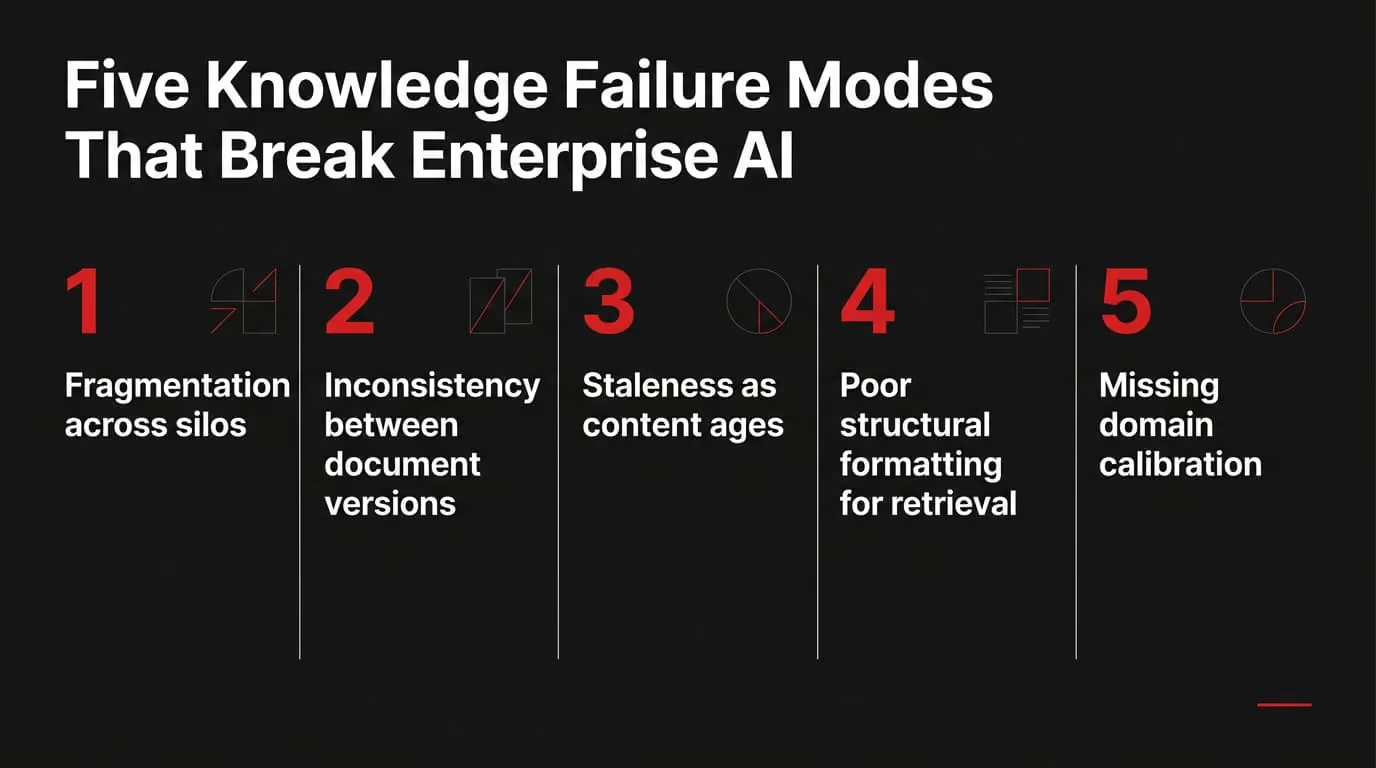
1. Fragmentation across silos
Knowledge lives in disconnected tools, departments, and systems. Customer data in one platform, operational data in another, domain expertise locked inside the heads of a few specialists. No connected data layer exists.
When AI models need to reason across these data sources, they work with an incomplete picture.
The result: AI outputs that miss critical business context and generate incomplete data for decision making. Without data integration across silos, even the most advanced machine learning models cannot produce accurate outcomes.
2. Inconsistency between document versions
In any large organisation, the same information exists in multiple versions. Policies get updated but old versions persist. Product specifications change but downstream databases stay out of sync.
This creates data integrity problems that are invisible to the AI system but obvious to anyone with real AI domain expertise. Models trained on inconsistent data produce inconsistent outputs. Duplicate records, conflicting facts, and missing values compound silently across the system until someone notices a bad decision that traces back to bad data.
3. Staleness as content ages
Data evolves. Markets shift. Regulations change. Products are updated. But the knowledge bases that feed AI systems are rarely maintained with the same urgency as the models that consume them. Data drift, where the properties of input data change over time, is one of the key challenges for maintaining data quality.
When live data starts to drift too far from the data the model was trained on, performance drops. Without data quality monitoring and continuous monitoring, you usually only notice it once business operations are already affected. By then, trust is already damaged.
4. Poor structural formatting for retrieval
Many organisations have vast knowledge assets. But those assets are stored in formats that AI tools cannot reliably parse: scanned PDFs, unstructured emails, poorly tagged wikis, spreadsheets with inconsistent formats. Data preparation for AI is not just about data cleaning.
It is about ensuring that knowledge is structured in ways that machine learning algorithms can actually work with. This includes data mapping, consistent formats, proper metadata, and clear taxonomies. Without this structural work, retrieval systems return fragments instead of answers. And your data pipelines carry noise instead of signal.
5. Missing domain calibration
Even when data is clean, complete, and well-structured, it may still lack the domain-specific calibration needed for accurate data that drives reliable AI models.
AI systems do not inherently know which data points matter most in a given business context.Without domain experts to validate the data and put it into context, the output may be technically right but not useful to the people who rely on it.
This is the gap between traditional data quality and AI data quality. For that, clean data is only the starting point. It also needs to be calibrated to the decisions the system must support. And this is where your AI competitive advantage is built or lost.
Why Bad Data Becomes Dangerous in Agentic Systems
Here is where things get truly dangerous.
In a simple retrieval system, a data quality issue produces a bad answer. That is a problem you can catch with data validation checks and fix before it reaches the user.
But in an agentic workflow, the stakes are fundamentally different. Multiple enterprise AI agents coordinate across multi-step processes. A single retrieval error no longer stays contained. It cascades.
How bad data compounds across agents
An orchestrator agent passes flawed data to an executor agent. The executor acts on it. A validator agent checks the output against equally flawed reference data and approves it. The error propagates through data pipelines and into business operations before anyone notices.
In a traditional system, poor quality data gives you a wrong answer. In an agentic system, it gives you a wrong answer that triggers a chain of wrong actions. The compounding effect is exponential.
This is why AI data quality is not just a data team concern. It is an architectural concern for anyone building AI systems at scale. The more autonomous your AI becomes, the higher the cost of bad data. And the harder it becomes to trace failures back to the knowledge layer where they originated.
It is also why scaling GenAI without first addressing data quality is a recipe for expensive failure. You cannot automate what you cannot trust.
Three Steps to Resolving Knowledge Quality
At Faktion, we approach AI data quality management through three interconnected principles. These are not one-time data preparation activities. They are ongoing operational requirements that must be embedded into every AI system that reaches AI in production.
1. Structured understanding of the knowledge base
Most organisations index their documents and call it done. From our perspective, that is just the tip of what is needed.
High quality data for AI requires building a semantic taxonomy: a structured, deep understanding of how documents relate to each other, what topics they cover, who they serve, and how they should be weighted. This means investing in data profiling, metadata enrichment, and content segmentation. It means using AI driven data quality tools alongside human expertise to create a knowledge layer that AI models can actually reason with.
The market for these tools is maturing fast. Open-source solutions like Great Expectations for automated data validation and Soda Core for data observability are giving enterprise data teams more options than ever. But tools alone are not enough. You need domain expertise to configure them correctly.
For organisations dealing with complex knowledge environments, building an AI knowledge management system is often the essential first step. It forces you to structure what you know before asking AI to reason with it.
2. Intent alignment: mapping knowledge to real queries
Here is a data quality problem that traditional data quality approaches miss entirely.
Your knowledge might be accurate, complete, and well-structured. But if it is organised around how your internal teams think about information rather than how users actually phrase their questions, your AI system will still return poor results. This is a quality issue that no amount of data cleaning will solve.
Intent alignment means mapping knowledge to real-world query patterns:
- How do people ask questions through natural language interfaces?
- What terminology do they use that differs from internal documentation?
What matters to a frontline employee is not the same as what matters to a data engineer looking at a schema.
This is where data observability meets user experience design. And it is where AI data quality becomes a competitive differentiator: not in the model, but in how well the knowledge layer is calibrated to the people who depend on it.
3. Continuous validation through domain expert review
Data quality is not a launch activity. It is an ongoing operational requirement. AI data quality management demands continuous monitoring, regular data quality checks, and systematic expert oversight.
This means building feedback loops where domain specialists validate AI outputs and flag quality issues before they compound. It means automated data validation that can automatically detect anomalies and data changes before they degrade model performance. It means data observability infrastructure that tracks data quality dimensions across the entire pipeline. And it means treating data quality management as a permanent line item in your AI budget, not a project cost you absorb once.
At Faktion, we embed this through our evaluation-driven development approach. Domain experts continuously validate system outputs. Every trace of feedback is structured and fed back into data pipelines that improve model performance over time. This is how you maintain reliable AI systems: not through better machine learning, but through better, continuous data quality management.
Knowledge Is Infrastructure, Not a Setup Task
If you are evaluating your next AI investment, pause and consider these questions:
- How much of your data preparation budget is allocated to ongoing AI data quality management versus one-time cleanup?
- Do your data teams have the tools and processes for continuous monitoring of data quality across all data sources?
- Can you trace a bad AI output back to the specific quality issue that caused it?
- Are domain experts involved in validating and calibrating the knowledge your AI systems rely on?
If the answers are uncertain, you are not ready to scale. And no model upgrade will change that.
At Faktion, we have seen this story play out across hundreds of AI projects. The organisations that succeed are the ones that treat AI data quality as infrastructure. Not as a phase. Not as a cleanup sprint before launch. But as the continuous, operational discipline that determines whether AI systems deliver real value or quietly fail.
Stop blaming the model. Start fixing the knowledge.
Ready to make your data the foundation your AI deserves? Get in touch and let's build data quality that scales.

.jpg)

.jpg)













.avif)