A very interesting Harvard Business Review article, link below, describes the “Gen AI wall” many organizations may be hitting.
The core message:
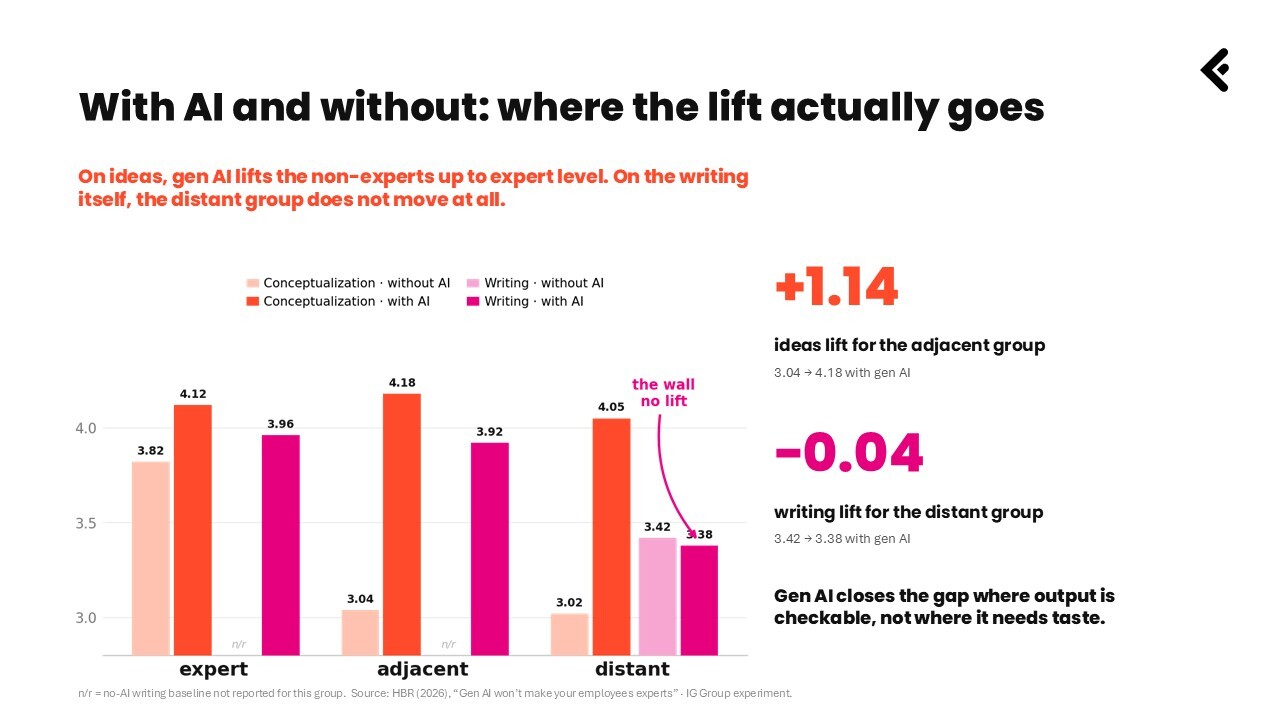
AI helps non-experts move much faster at the conceptual level.
But when work requires real execution, judgment and refinement, the gap between experts and non-experts does not disappear.
🔹 There is still a wall.
🔹 There is still a delta.
🔹 There is still an expertise gap
And that gap matters when you redesign work with AI.
Because this is not just about “experts versus non-experts”.
It is about several dimensions at once:
🔹 Experts vs adjacent experts vs distant non-experts
🔹 Narrow, verifiable tasks vs open-ended expert work
🔹 Task execution vs supervision and review
🔹 Prompting/specification vs deep task execution
🔹 Individual tasks vs workflows and end-to-end processes
🔹 Quality per output vs total throughput
🔹 Automation vs organization redesign
The article shows that Gen AI can almost close the gap in conceptual work. But in deep execution, the expertise gap remains.
AI helps you enter the conversation.
It does not automatically give you domain expertise to finalise the work or to engage in human discussions
We would add two important dimensions missing in the article though.
1 Quantity
If experts use AI well, they can become 5x or 10x more productive on specific tasks.
But if non-experts generate 5x or 10x more “almost good” work, experts may also get 5x or 10x more review work.
So the bottleneck moves:
🔹 From production
🔹 To supervision
🔹 To quality control
2 Task_types
The AI wall is much lower for narrow, structured and verifiable tasks:
🔹 Classification, Triage, Routing, Document extraction, Matching?
For those tasks, expertise can often be externalized into rules and evaluation criteria. That is where agentic systems become powerful.
They decompose work into smaller tasks, automate what is narrow and verifiable, and escalate what requires expert judgment.
So when we redesign processes with AI, we are also redesigning the organization.
Tasks become workflows. Workflows become processes. Processes define roles. Roles define organizations.
The real productivity gain will come from designing AI-native operating models where we know:
🔹 What can be automated
🔹 What requires human review
🔹 Which review can be done by juniors or non-experts
🔹 Where adjacent expertise is enough
🔹 Where true domain expertise is still required
So the Gen AI wall is not an obstruction to productivity. It is a design constraint. It shows us where we need to redesign workflows, where humans need to stay in control, and where expertise still matters.
Gen AI cannot manufacture taste and human sophistication. But it can manufacture leverage. And for most business work, leverage is what matters.
Article
Enjoy the article (but add quantity and narrow tasks to it as well)
Link to article
Let's talk!
We'll put some complemantary experts around the table.





.avif)