Hand-coded sorting rules and repeated manual work made model development difficult to scale across TOMRA Food’s global fleet. Together, TOMRA and Faktion built one global Vision AI and MLOps platform for teams to manage data, annotation, training, evaluation and controlled release. Model development now takes days instead of months, helping TOMRA support more customers and applications.

TOMRA Food, runs a connected fleet of machines that sort fruit, nuts and dried fruit, potatoes, protein, seeds and grains, and vegetables. Each product within those categories needs its own AI model. With a machines fleet that size, the global leader in sensor-based food sorting needed a scalable way to develop models and manage their release to machines. Since 2023, TOMRA Food has built a central MLOps platform with Faktion: one dedicated place where data scientists, application specialists and sales engineers work together, from collecting data to testing and releasing models.
With pixel-based segmentation, engineers have to encode each new edge case by hand. Deep learning lets them train on those cases instead. As the dataset grows, the classifier detects a wider range of defects and holds up better when season, geography or product variety changes. That’s why deep learning became a strategic priority for the company. To support it across the organisation, TOMRA Food productised MLOps and gave teams a common way to manage data, annotations, models and deployments.
TOMRA Food partnered with Faktion to build this platform. With over a decade of MLOps experience, Faktion productised the AI workflows through clear interfaces. Meaning, application specialists and sales engineers could collect data, improve models and manage deployments as part of daily operations.
It has to work at scale, because TOMRA Food organises its business around applications, and each product type needs its own classifier. These range from fruit, nuts and potatoes to protein, seeds, grains and vegetables, served by the 5X, 4C, 3A and Spectrim machine families using RGB, infrared, X-ray and spectral imaging.
However, scaling deep learning in a global organisation requires more than a high volume of data. It requires:
Alongside the platform work, Faktion built an in-house team specialised in spectral imaging. The team turned its research into practical annotation and labelling workflows for spectral images, an area the available tools did not yet cover.
What makes TOMRA so significant is its strategic importance on a global level. This is the core of TOMRA's business: sorting food to the next level through connected machines running on gigantic amounts of global data. And what we have built here is not generative AI or agentic AI. It is the pure power of classic deep learning, engineered to be state of the art and genuinely robust. Over a years-long partnership, TOMRA has had the vision and the courage to keep pushing that forward, at the right time, in the right place. Our cooperation with TOMRA FOOD is Faktion at its best: AI Product Studio as a Service. Together, we built a globally connected Vision AI ecosystem, combining custom AI, software engineering and MLOps into a single operating platform. A true dream cooperation.

Global data centralisation and MLOps collaboration platform
To address the challenges of scaling deep learning inside a global portfolio of machines and applications, TOMRA Food and Faktion designed and built a central MLOps platform for model development and deployment.
TOMRA added a shared operational layer so its reorganised global teams could work from one AI foundation while keeping their R&D processes and domain expertise. A layer that could support the full lifecycle of a classifier, from data ingestion and annotation to training, evaluation, release and deployment tracking over machines, applications and regions.
Training data, annotations and metadata are managed in one platform, reducing duplicated work. Customers choose whether to share their data for model improvements.
Data is organised by use case and product category, creating a shared foundation while preserving the ability to handle product-specific defects, varieties and regional differences.
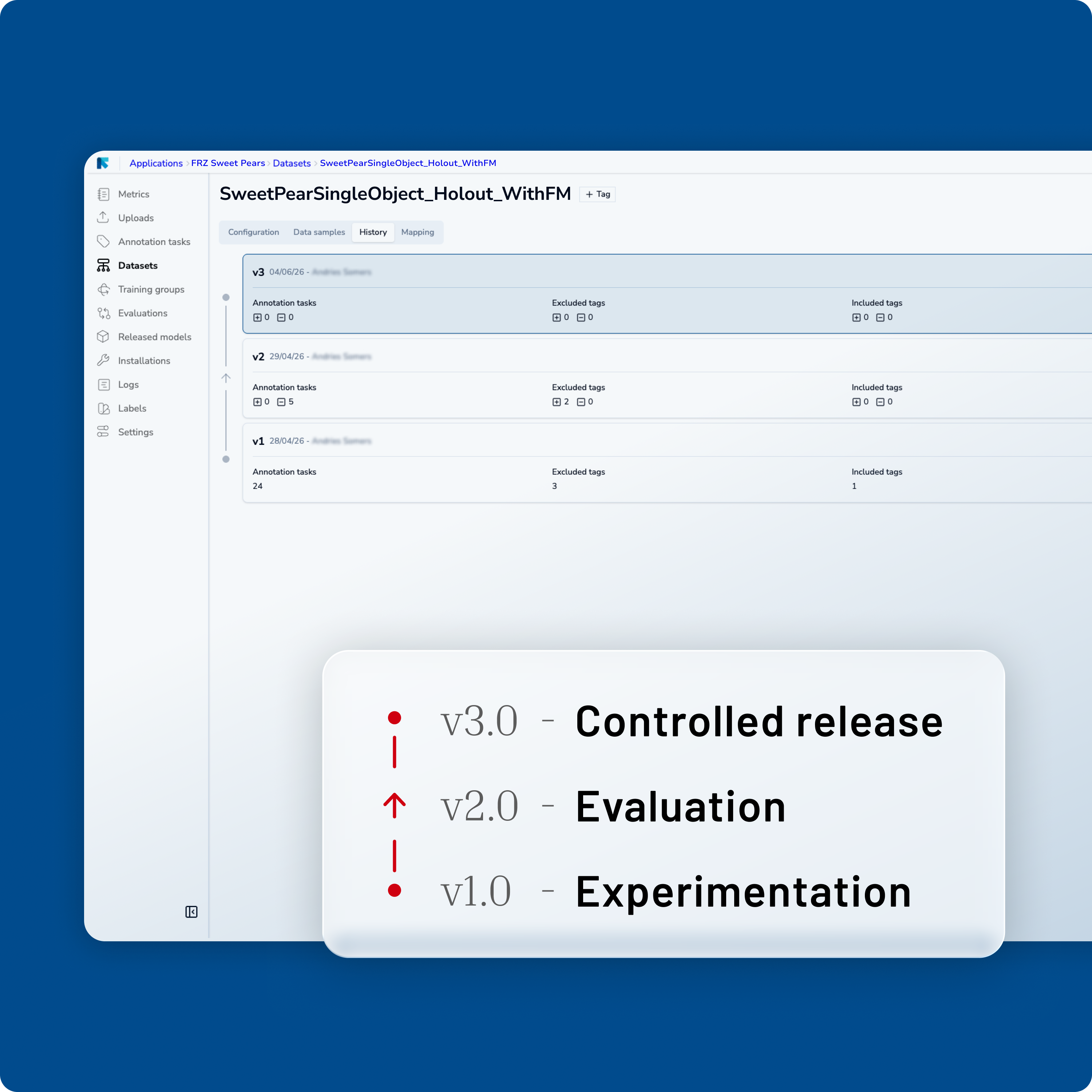
Every dataset is versioned, ensuring full traceability from raw sensor data through training runs to production-ready classifiers.
Teams use a lifecycle to take models from experimentation to controlled release. This gives them a faster route to production with quality and governance controls built into each stage.
One central platform supports classification, bounding boxes, segmentation and multi-view workflows. It works with RGB, infrared, X-ray and spectral data and adapts to each machine family.
The platform supports reuse of models and datasets for the same application. Each customer decides whether to share its data to help improve sorting models.
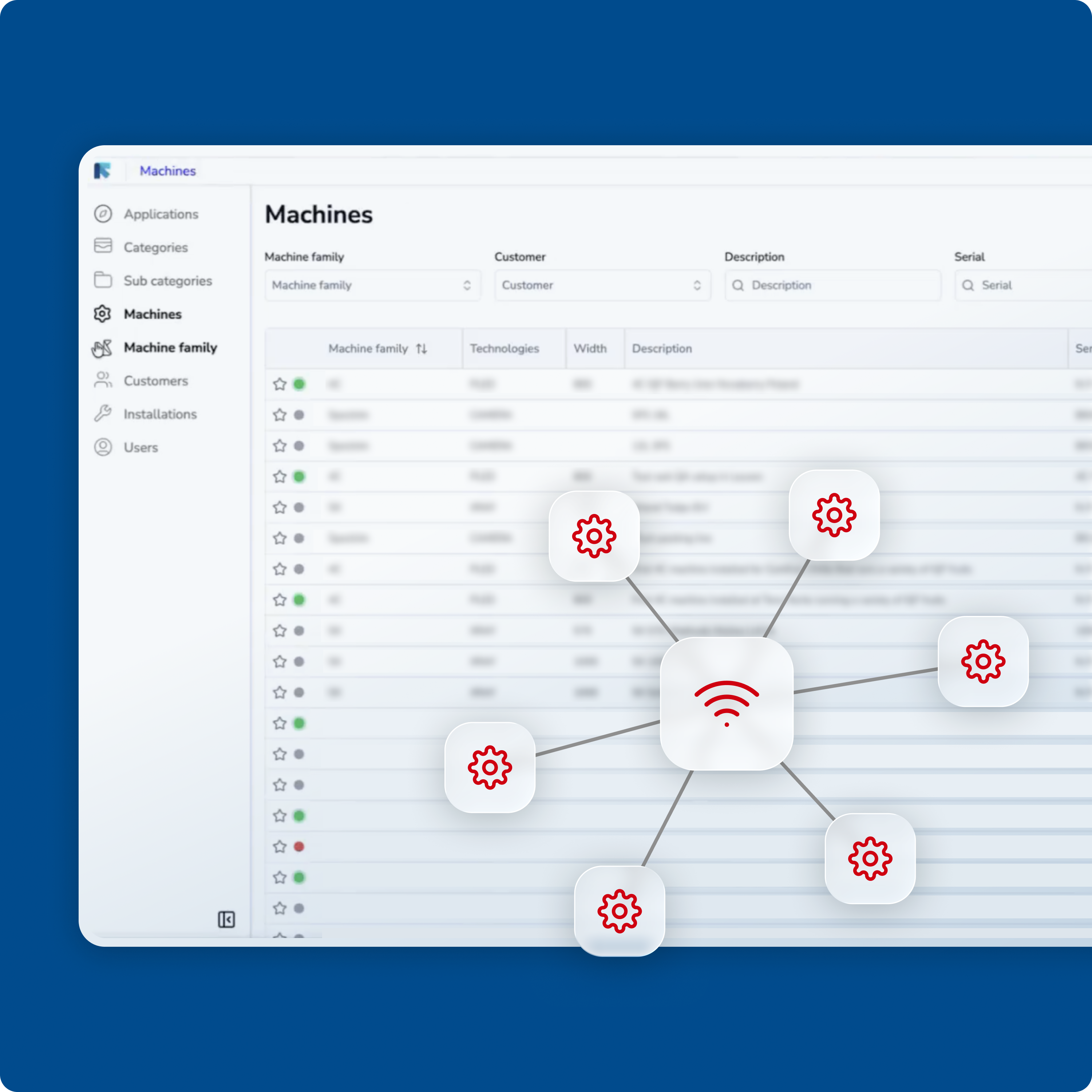
Machines connect securely to the platform, giving data scientists the input they need to train customer-specific models. The machines then receive each model through one controlled action and keep it ready until the customer schedules installation.
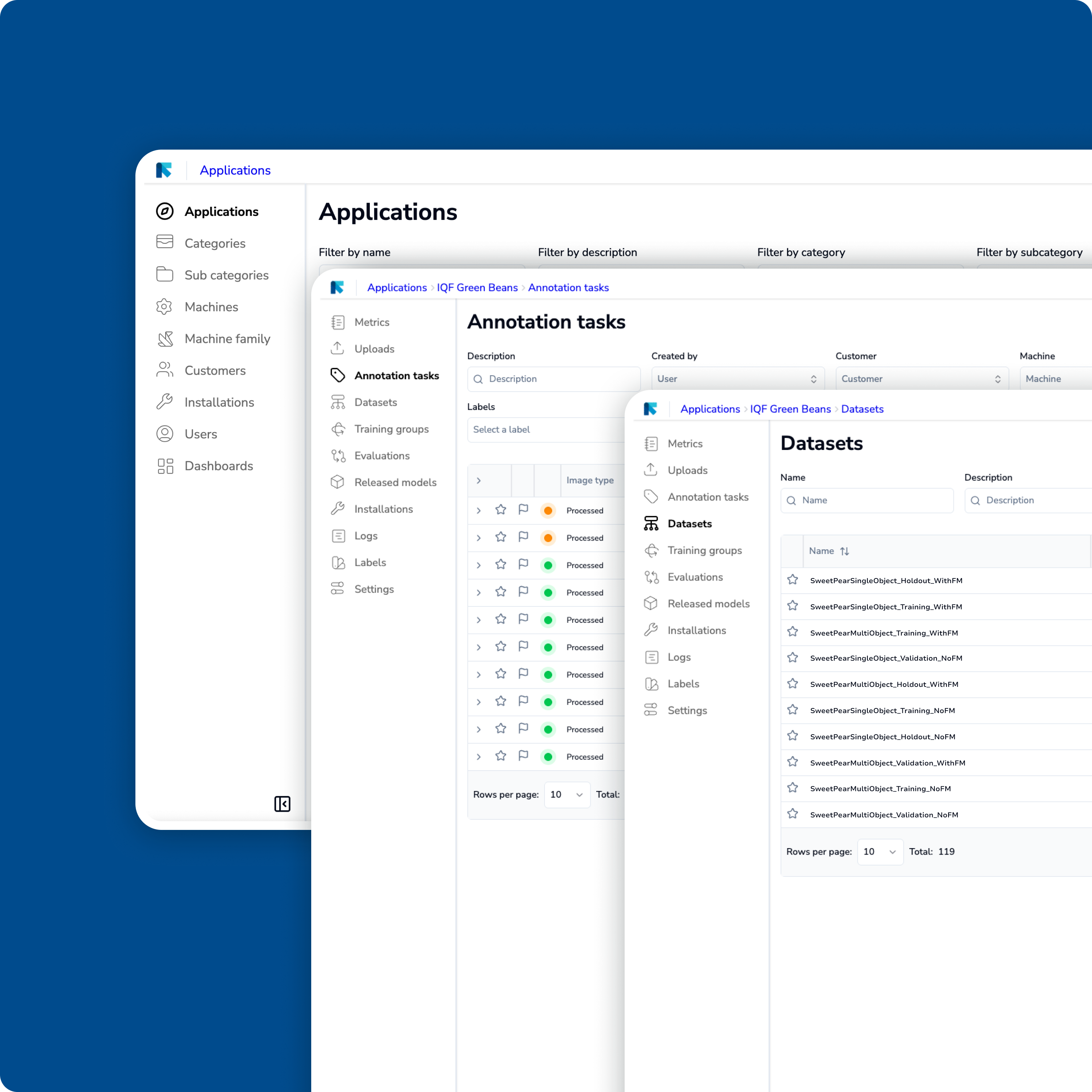
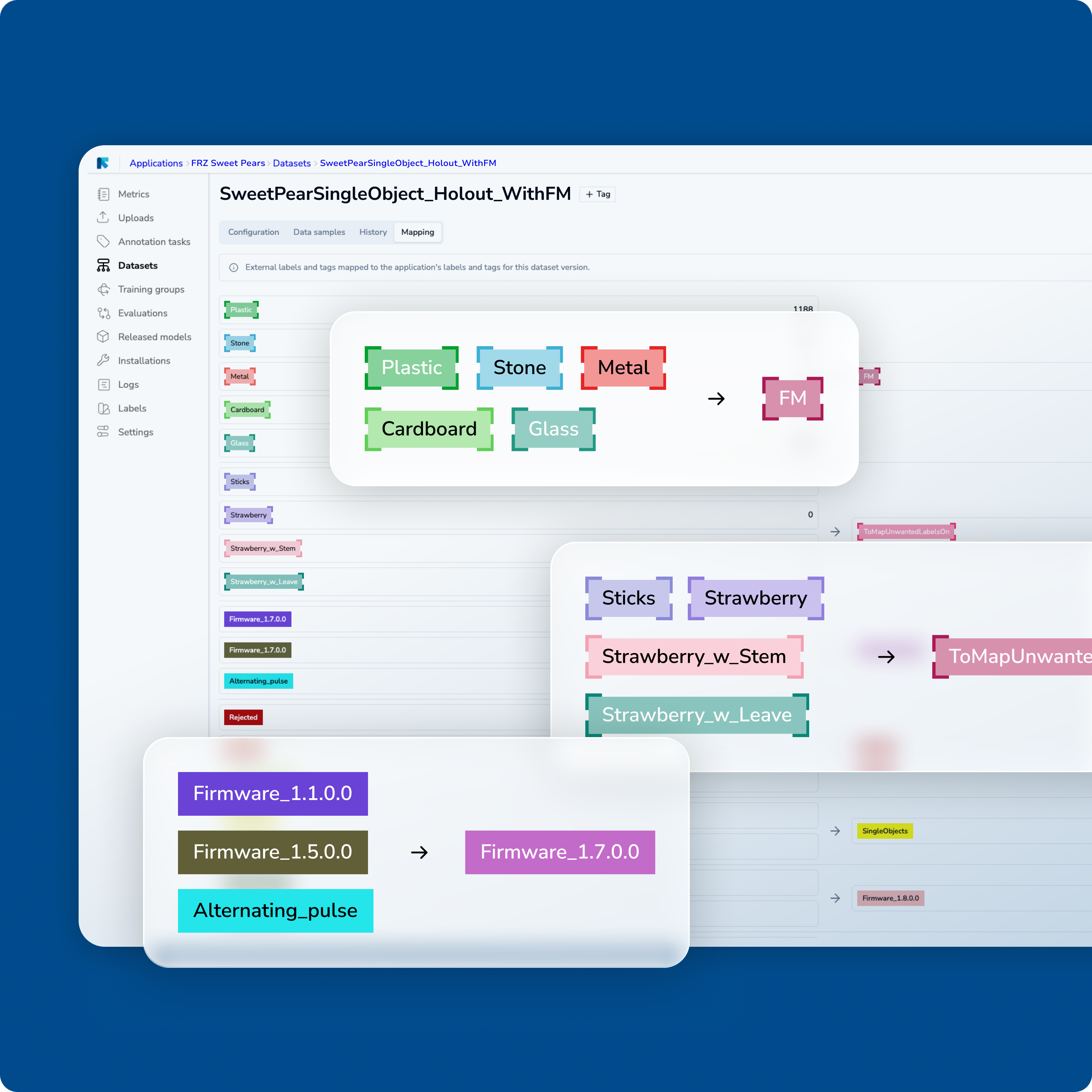
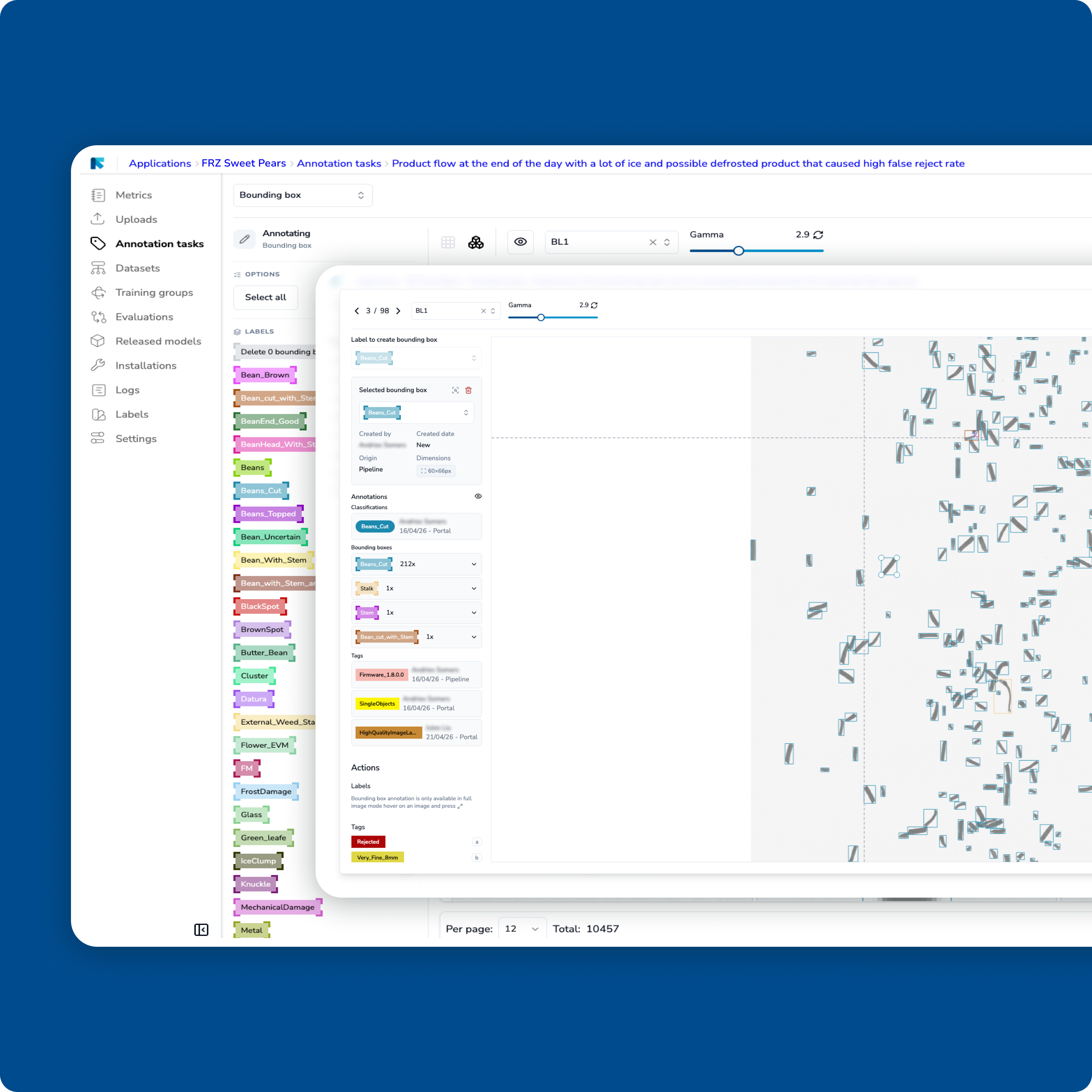
Training data, annotations and metadata are managed in one platform, reducing duplicated work. Customers choose whether to share their data for model improvements.
Data is organised by use case and product category, creating a shared foundation while preserving the ability to handle product-specific defects, varieties and regional differences.
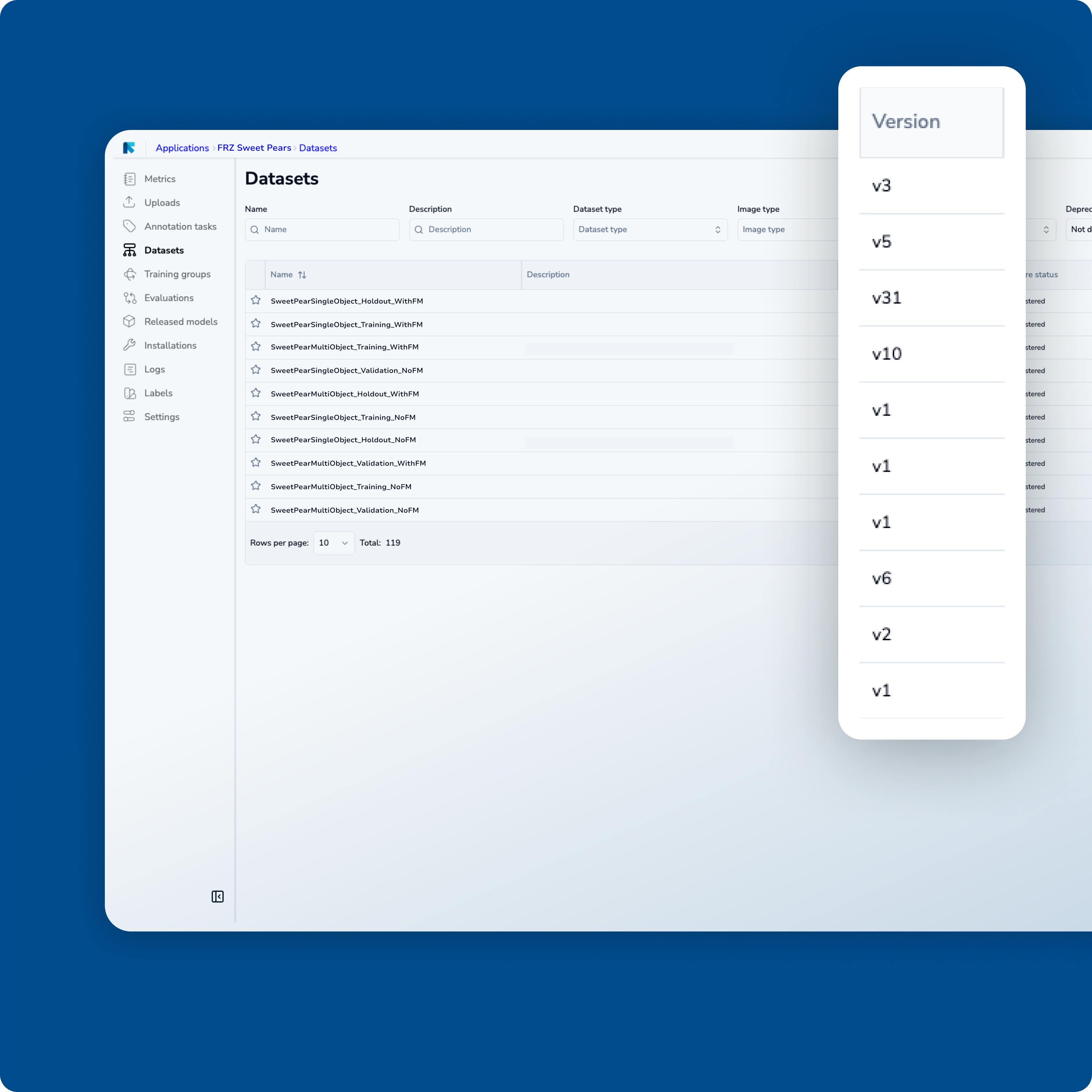
Every dataset is versioned, ensuring full traceability from raw sensor data through training runs to production-ready classifiers.
Teams use a lifecycle to take models from experimentation to controlled release. This gives them a faster route to production with quality and governance controls built into each stage.
One central platform supports classification, bounding boxes, segmentation and multi-view workflows. It works with RGB, infrared, X-ray and spectral data and adapts to each machine family.
The platform supports reuse of models and datasets for the same application. Each customer decides whether to share its data to help improve sorting models.
Machines connect securely to the platform, giving data scientists the input they need to train customer-specific models. The machines then receive each model through one controlled action and keep it ready until the customer schedules installation.
Approach
Both sides wanted to move quickly, and with teams in Belgium and New Zealand, everyone had to build to the same standard. That meant short iterations, each one ending in a demo for the data scientists, application specialists and sales engineers who would use the platform. In those sessions the teams caught wrong assumptions within weeks. They also built edge cases from the field into the design before it locked.
Faktion stepped in with senior expertise to stabilise progress:
By involving TOMRA Food's teams throughout development, Faktion transferred knowledge during the build. As a result, both teams kept their momentum and delivery stayed on schedule.
Ownership was shared, but each side knew what it was responsible for: TOMRA Food kept control of the product roadmap and of how teams inside the company took the platform up. Meanwhile, Faktion brought specialist expertise into those teams where they needed it.
That balance helped the platform become part of daily work at TOMRA Food. Data scientists, application specialists and sales engineers use it every day and keep improving it.
Faktion worked as a true extension of our team. Their experienced data scientists and full-stack developers helped bridge two worlds that are often difficult to connect, while keeping communication close and delivery on track.

Through this collaboration, the platform became the base of TOMRA Food's AI operations. Teams now use it to develop, deploy and scale models.





%201.avif)